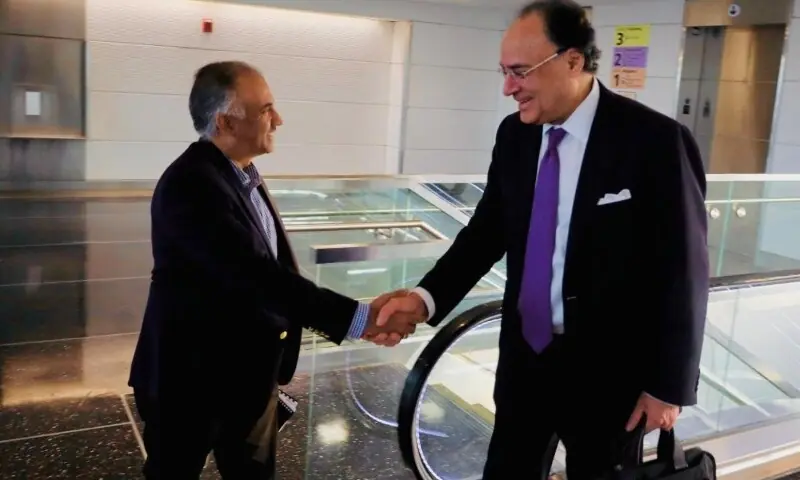
Finance Minister Muhammad Aurangzeb has arrived in Washington, D.C. to attend the World Bank Group and International Monetary Fund (IMF) Spring Meetings 2026, as Pakistan continues efforts to strengthen its economic reform agenda amid global uncertainty.
Read More: Aurangzeb meets IMF to assess EFF progress
According to Pakistan’s Ministry of Finance, the minister will participate in high-level discussions with global financial leaders, policymakers, and development experts during the week-long gathering taking place from April 13 to 18. The meetings bring together finance ministers and central bank governors from around the world to address pressing economic challenges, including inflation, debt sustainability, and financial stability.
Finance Minister Senator Muhammad Aurangzeb arrives in Washington for World Bank-IMF Spring Meetings 2026. Following engagements at Harvard, the Minister will hold key meetings with global financial leaders to advance Pakistan’s reform agenda and economic priorities. pic.twitter.com/fBST3rOh3t
— Ministry of Finance, Government of Pakistan (@Financegovpk) April 13, 2026
During his visit, Aurangzeb is expected to present Pakistan’s economic outlook, reform trajectory, and growth prospects. Officials said he will also engage with leading academics and members of the Pakistani diaspora to highlight ongoing macroeconomic stabilisation efforts and structural reforms.
The finance minister is scheduled to hold key meetings with senior officials of the International Monetary Fund (International Monetary Fund), including First Deputy Managing Director Dan Katz, Deputy Managing Director Nigel Clarke, and Director of the Middle East and Central Asia Department Jihad Azour. Discussions are expected to focus on Pakistan’s fiscal consolidation measures and continued cooperation with international financial institutions.
The visit comes at a time when global economic conditions remain uncertain, with ongoing geopolitical tensions affecting energy markets and commodity prices. Recent developments have prompted coordination between major international institutions, including the IMF, World Bank, and International Energy Agency, to monitor disruptions in global supply chains and energy flows.
Officials said Pakistan’s participation in the Spring Meetings reflects its commitment to macroeconomic stability and strengthening partnerships with global stakeholders to support sustainable and inclusive growth.
The IMF has warned that recent geopolitical conflicts have contributed to volatility in oil and gas markets, tightening financial conditions and increasing the cost of essential commodities such as food and fertiliser, adding further pressure on developing economies.
Read More: Pakistan ready for IMF $1.2b review: FinMin
Pakistan’s delegation is expected to continue engagement throughout the meetings, focusing on long-term economic resilience and investment opportunities.