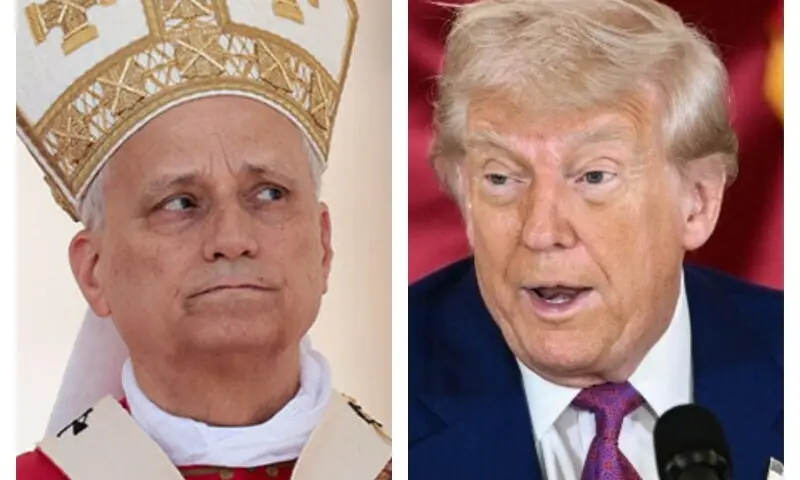
US President Donald Trump has said he is “not a big fan” of Pope Leo XIV following the pontiff’s renewed call for peace and an end to violence amid escalating tensions linked to the war involving Iran.
Read More: Pope Leo XIV urges Easter peace in Iran conflict
Speaking to reporters at Joint Base Andrews in Maryland, Trump described the Pope as “a very liberal person” and accused him of failing to take a strong stance on crime and security issues. The comments came shortly after Pope Leo publicly urged global leaders to stop the conflict, warning against what he called the “idolatry of power” and calling for urgent diplomatic solutions.
— Rapid Response 47 (@RapidResponse47) April 13, 2026
The Pope, addressing worshippers at St. Peter’s Basilica, had appealed for an immediate end to war and criticized global leaders for escalating military confrontation. His remarks were widely interpreted as a moral critique of ongoing geopolitical tensions, particularly surrounding the Iran crisis and recent diplomatic breakdowns.
Trump, however, rejected the Pope’s position and argued that Leo’s message undermines efforts to prevent Iran from developing nuclear capabilities. He reiterated his stance in a social media post, stating that he did not want a religious leader who believes it is acceptable for Iran to possess nuclear weapons.
The exchange highlights growing tension between the White House and the Vatican, as Pope Leo has increasingly spoken out against military escalation, while the Trump administration has taken a hardline approach in its foreign policy.
Recent developments have further intensified global concern, with failed peace negotiations and rising instability in the Middle East contributing to diplomatic strain. The Vatican has repeatedly urged restraint, while US officials maintain that strong measures are necessary to address security threats.
Read More: Pope Leo condemns war, says God rejects violent leaders
Despite the sharp criticism, both sides have not formally confirmed a breakdown in diplomatic or informal communication channels. Observers say the public disagreement reflects deeper ideological differences over war, diplomacy, and the use of military force in resolving international disputes.