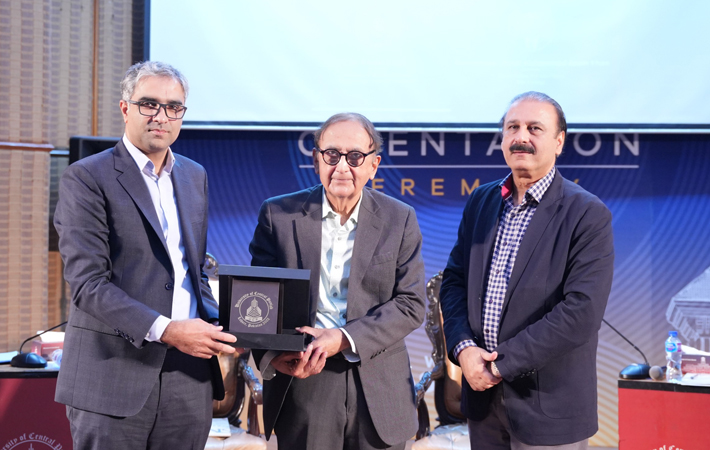
 A seminar titled “Middle East War and South Asia,” organized by the Faculty of Humanities and Social Sciences of a local university, brought together national and international experts to discuss the evolving regional situation. Key speakers included former caretaker Chief Minister of Punjab Dr. Hasan Askari Rizvi, retired Air Marshal Shahid Akhtar Alvi, Professor Dr. Balveer Singh from the National University of Singapore, and Commodore (R) Muhammad Azam Khan.
Dr Hasan Askari Rizvi stated that the war has not only impacted the direct parties involved but has also pushed the entire region into economic and security crises. He rejected the perception that Iran would weaken immediately, emphasizing that internal self-reliance has emerged as a major strength for the country.
Air Marshal Shahid Akhtar Alvi noted that the conflict is unique in the sense that a regional power has directly challenged global forces. He added that in the changing scenario, the negotiation agenda appears to be shifting into Iran’s hands, while the final outcome of the war remains uncertain.
Commodore Muhammad Azam Khan highlighted modern warfare technologies, particularly drones and precision missiles, as key factors reshaping the nature of war, adding that the conflict signals a shift in the global balance of power. Dr. Balveer Singh warned that the effects of this war will be long-term and may lead to further instability in the region.
In his concluding remarks, Professor Dr. Khalid Manzoor Butt stated that the war is laying the foundation for a new multipolar world order, where self-reliance and regional alliances will gain increasing importance.