
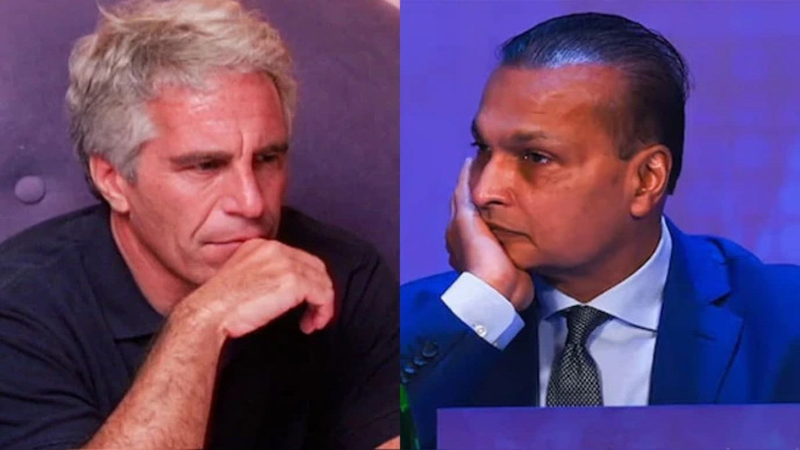
 In early 2017, as the administration of Donald Trump took shape, Anil Ambani sought guidance from an unlikely source.
“Will need ur guidance on dealing wth white house for india relationship ad defense cooperation,” he wrote in a message to Jeffrey Epstein. Epstein replied that he would provide “inside baseball.”
The exchange was part of hundreds of messages reviewed by investigators, spanning roughly two years. They show a sustained line of communication between a leading Indian businessman and a man who had pleaded guilty in 2008 to soliciting prostitution from a minor and was a registered sex offender.
Epstein did not hold any formal role in the Trump administration. He nonetheless presented himself as a source of insight into U.S. policy and personnel decisions. In March 2017, when Ambani asked about David Petraeus as a possible U.S. ambassador to India, Epstein replied that he had been “told” the name was not on the “front burner.” Petraeus was not appointed.
Months later, Epstein told Ambani that John Bolton would replace H.R. McMaster as national security adviser, writing that Bolton was “next” and that McMaster “was not long for the position.” Bolton was appointed to the role eight months later.
The messages indicate that Epstein offered to arrange introductions to figures with proximity to the White House, including Stephen Bannon and Thomas Barrack. He also suggested ways in which India’s foreign policy positioning could be viewed more favourably in Washington, including closer alignment with Israel during a period when U.S. policy was emphasising regional partnerships.
At the time, India was expanding defence ties with Israel, with purchases estimated at about $2 billion in 2017. That year, Narendra Modi became the first Indian prime minister to visit Israel.
The correspondence shows Ambani engaging Epstein on issues ranging from diplomatic appointments to strategic positioning. The tone of the exchanges suggests reliance on Epstein’s inputs, despite the absence of evidence that he held official influence in U.S. decision-making.
Ambani’s outreach occurred during a period of significant financial change. His estimated net worth declined from around $45 billion in 2007 to about $1.7 billion by 2019. During that period, his business interests included involvement in defence manufacturing linked to the Rafale fighter jet deal, which drew political scrutiny in India.
Communication between the two men continued into 2019, as Ambani faced mounting debt and legal pressure related to unpaid dues. In one exchange, Epstein wrote, “No money for me. I have enough,” indicating he was not seeking payment for his involvement.
The messages document a relationship in which a convicted offender remained in contact with senior business figures and positioned himself as an intermediary on matters of international policy.
The broader implications of such interactions have drawn scrutiny in recent months, as investigators and lawmakers in the United States continue to call for fuller disclosure of Epstein’s communications and contacts. Advocates for victims have argued that incomplete transparency has obscured the extent of his network and the individuals who engaged with him.
The Ambani exchanges provide a partial view into that network. They show how Epstein continued to communicate with influential figures years after his conviction, offering access, advice, and introductions in areas that extended beyond finance into geopolitics.