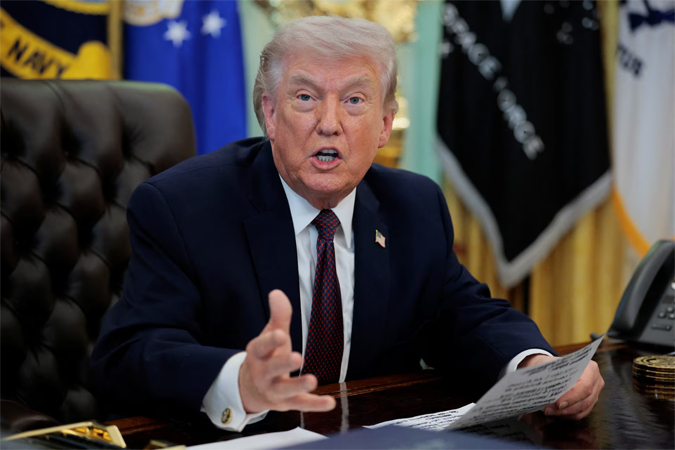
 The United States will be “out of Iran pretty quickly” and could return for “spot hits” if needed, President Donald Trump told Reuters on Wednesday, hours before he was scheduled to make a primetime address to the nation about the Middle East war.
Separately, Iran on Wednesday rubbished the claim from United States President ?Donald Trump that a new leader had just asked the United States for a ceasefire.
“Iran’s new regime president, much less radicalised and far more intelligent than his predecessors, has just asked the United States of America for a ceasefire,” Trump wrote on his social media platform Truth Social.
Washington would consider the request only when the strait was “open, free and clear”, he said, warning it would continue striking Iran “into oblivion or, as they say, back to the stone ages” in the meantime.
According to Iran’s IRIB news agency, Foreign Minister Abbas Araghchi said no ceasefire proposal was made.
He also said that a five-point plan allegedly proposed by Iran was “media speculation”, adding that the war would continue until “the aggressor is punished and full compensation is paid to Iran”.
Araghchi told Al Jazeera the same, saying that Iran was seeking an end to the war and guarantees that such aggressions would not be repeated.
Iranian Foreign Ministry spokesman Esmaeil Baqaei rejected Trump’s claim, saying that Tehran asking for a ceasefire did not reflect reality.
Axios, citing three US officials, reported that discussions were underway about a ceasefire in exchange for the reopening of the Strait of Hormuz.
Officials said Trump was actively discussing the possibility with figures inside and outside his administration, but cautioned that it remained unclear whether a deal could be reached. Sources did not specify whether the discussions were taking place directly with Iran or through mediators such as Pakistan.
Meanwhile, the United Arab Emirates is preparing to support US-led efforts to reopen the Strait of Hormuz by force, according to a Wall Street Journal report.
Citing Arab officials, the outlet reported that the UAE is lobbying for a UN Security Council resolution that would authorise military action and is urging the US and military powers in Europe and Asia to form a coalition to secure the strategic waterway. The Gulf state is also reviewing potential military roles, including mine-clearing operations, as it weighs becoming a direct participant in the conflict for the first time, the report said.
In a statement cited by the Wall Street Journal, the UAE Foreign Ministry said there is “broad global consensus that freedom of navigation in the Strait of Hormuz must be preserved,” pointing to international condemnation of disruptions in the waterway.
Separately, US-Israeli strikes have hit steel complexes in central and southwest Iran, damaging production units, Iranian media reported.
“Initial assessments indicate massive attacks, with significant damage and destruction to production units” at the complex of the Mobarakeh Steel Company, one of Iran’s biggest, in the central province of Isfahan, Fars news agency reported, quoting a statement by the company.
According to Al Jazeera, Fars said one of the company’s subsidiaries, Sefid Dasht Steel, in the southwestern Chaharmahal and Bakhtiari province, had also “sustained damage and losses”.
Attacks were reported on both sides early on Wednesday, with drones hitting fuel tanks at Kuwait’s international airport, causing a big blaze and authorities in Bahrain reported a fire at an undisclosed company facility from an Iranian attack.
A tanker was hit by an unknown projectile near the Qatari capital Doha, causing damage to the hull at the waterline, the United Kingdom Maritime Trade Operations said, adding the crew was safe.
Explosions were heard in multiple areas of Tehran early Wednesday after US-Israeli air attacks, Iranian state media reported, adding that its air defences were activated.
Shahid Haghani Port, Iran’s largest passenger terminal located in Bandar Abbas port on the Gulf, was hit by an overnight air strike, but there were no casualties, the deputy governor Ahmad Nafisi told state media, calling it a “criminal” attack against civilian infrastructure.