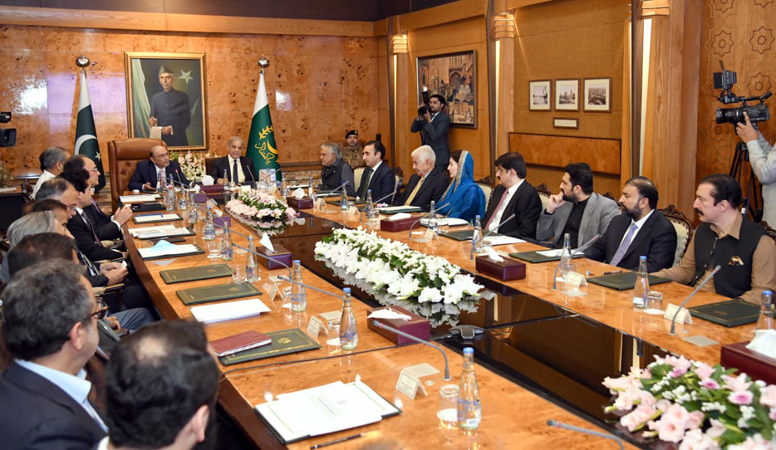
 President Asif Ali Zardari has directed that amid oil and gas supply pressures, escalating energy costs, and the evolving regional environment, all possible measures should be taken to ease the burden of rising prices on the common man, especially for essential goods and services.
The President said this while chairing an expanded consultative meeting at Aiwan-e-Sadr in which Prime Minister Muhammad Shehbaz Sharif and leadership of provinces as well as Gilgit Baltistan and Azad Jammu and Kashmir (AJ&K) also participated.
The meeting was briefed on the steps being taken by governments of the four provinces as well as of Gilgit Baltistan and AJ&K to manage price pressures, ensure availability of essential supplies and mitigate the impact on the public, enabling a coordinated national response.
The meeting also reviewed the broader regional situation and its potential effects on Pakistan’s security environment, economic outlook and food security. The meeting was assured that despite the global crisis, timely decisions have ensured no disruption to fuel supply, and that adequate fuel stocks are currently available to meet the country’s needs, with arrangements for the future also underway.
Deputy Prime Minister and Foreign Minister informed the meeting about the government’s proactive diplomatic outreach, including his recent engagements with the leadership of Türkiye, Saudi Arabia and Egypt, as well as leaders of countries involved in the conflict. He also briefed the meeting on his upcoming visit to Beijing.
The meeting was informed that proposals to increase oil prices had repeatedly been rejected by the Prime Minister, and that funds saved through austerity measures were being channelled towards public relief. It was noted that the spirit of austerity had begun with the government cutting down its own expenditure, including cuts to the development budget and the immediate grounding of 60 percent of official vehicles.
The President reiterated that the economically vulnerable people would not be left alone in this difficult time. He directed that coordinated decision-making should be done, with alignment between economic management, energy planning, food security measures and security preparedness.
The President also asked for the need for public awareness efforts, focusing on reducing fuel consumption, encouraging the use of public transportation and promoting shared mobility practices as part of a broader demand management approach.
Separately, European Council President Antonio Costa on Monday reaffirmed diplomatic support for Pakistan’s peace efforts in the Middle East to Prime Minister Shehbaz Sharif, stating that only dialogue and diplomacy could bring peace to the region.
According to a statement issued by the Prime Minister’s Office (PMO) on X today, Costa and PM Shehbaz discussed the ongoing hostilities in the Middle East and exchanged views on Pakistan-EU relations.
“Both leaders expressed their deep concern over the ongoing hostilities in Iran and the Gulf countries and their impact on the global economy. They stressed the need to resolve the crisis through dialogue and diplomacy,” the statement read.
The PMO further stated that the prime minister also shared the latest developments in Pakistan’s mediation efforts to de-escalate the Middle East crisis. Costa endorsed Pakistan’s peace efforts and reaffirmed that the EU supported all diplomatic initiatives aimed at restoring peace and stability in the region.
“PM Shehbaz highlighted the importance of GSP Plus and mentioned that he looked forward to inaugurating the first-ever Pakistan-EU Business Forum in Islamabad on April 28-29,” the statement added.
According to the PMO, the prime minister recalled that his scheduled visit to Brussels had to be postponed last month, emphasising that Pakistan attached great importance to its relations with the EU.
“The EU Council president said he looked forward to welcoming the prime minister in Brussels on mutually convenient dates,” the statement further noted.
The statement also mentioned that PM Shehbaz conveyed his good wishes to European Commission President Ursula von der Leyen.
Separately, on X, Costa stated, “Good call today with the prime minister of Pakistan to hear his assessment on the Iran war, as well as the outcome of the recent consultations between the foreign ministers of Egypt, Saudi Arabia, Pakistan and Türkiye held in Islamabad.”
“The EU is gravely concerned about the prolongation of the war and its increasing global impact. I wish Pakistan all the best in its peace endeavours,” he added.
He further noted that the EU supported all mediation efforts, stating, “Only dialogue and diplomacy can bring peace and stability back to the Middle East, in full respect of the UN Charter and international law.”
Earlier, Shehbaz Sharif on Monday thanked the foreign ministers of Saudi Arabia, Turkiye and Egypt for expressing confidence in Pakistan’s sincere efforts for peace and stability in the region.