

LAHORE: A serious breach of security protocols has been reported within the Lahore Qalandars camp during the ongoing 11th edition of the Pakistan Super League (PSL).
According to official sources and a formal correspondence from the DIG Operations, several players allegedly bypassed Pakistan Cricket Board (PCB) security mandates at a local hotel on the night of March 28.
The incident began at approximately 10:35 PM when the Liaison Officer for the Lahore Qalandars contacted Lt. Col. (Retd) Akhtar Hussain, PCB’s Manager of Security and Anti-Corruption. The officer requested permission for four guests, identified as relatives of all-rounder Sikandar Raza, to visit the player’s private quarters.
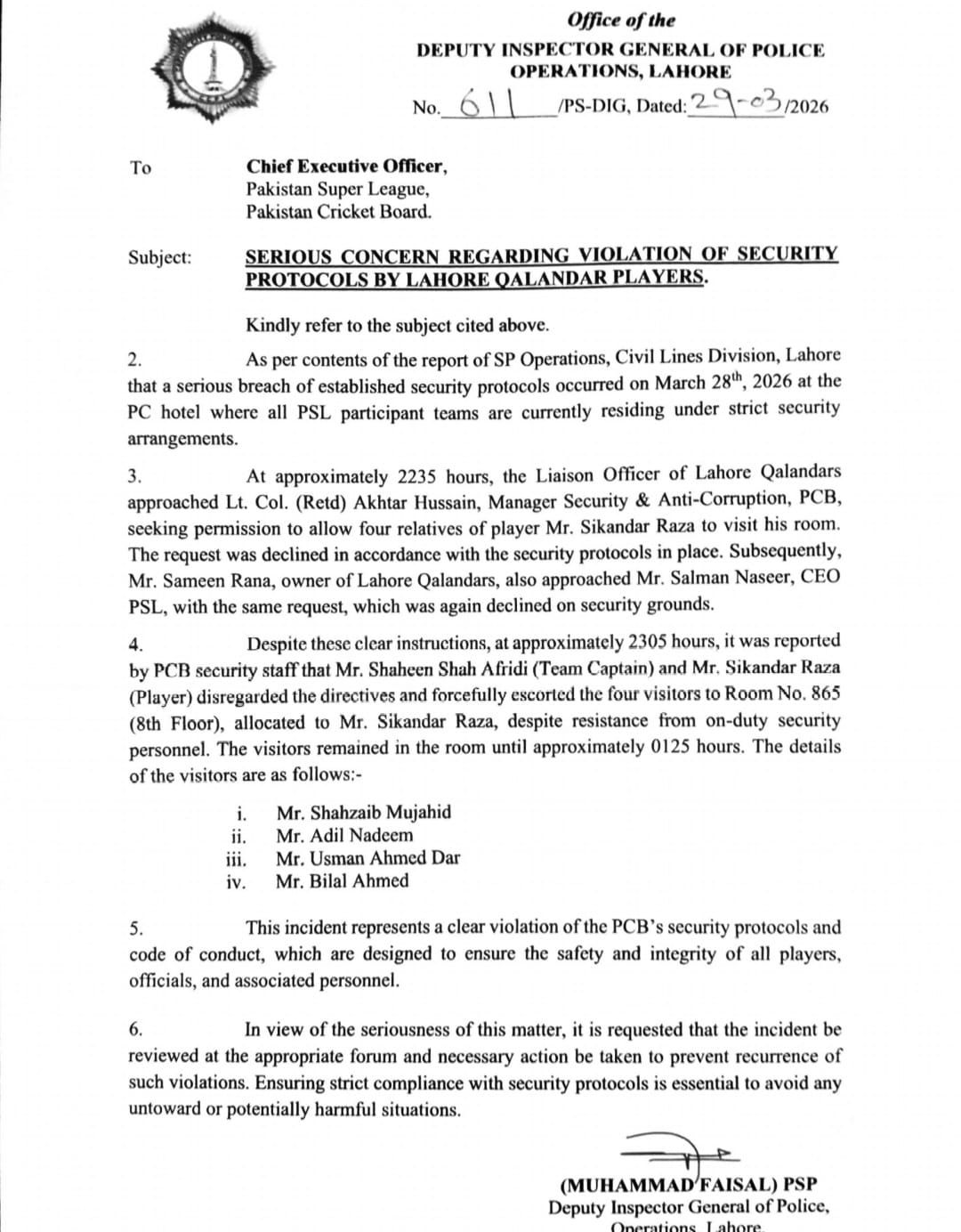
In accordance with the stringent security and anti-corruption protocols currently in place for the tournament, the PCB officially denied the request.
Following the initial refusal, the owner of Lahore Qalandars, Mr. Sameen Rana, reportedly escalated the matter to Salman Naseer, CEO of the PSL. Despite this intervention, the request was once again declined on security grounds.
However, a report from the security detail on-site indicates that by 11:05 PM, team captain Shaheen Shah Afridi and Sikandar Raza allegedly disregarded these directives. The report states that the players bypassed security personnel to escort four unauthorized individuals to Room 865 on the 8th floor, which was assigned to Raza.
The unauthorized guests, identified as Shahzaib Mujahid, Adil Nadeem, Usman Ahmed Dar, and Bilal Ahmed, remained in the room until approximately 01:25 AM.
The SP Operations (Civil Lines Division) has categorized the event as a “grave violation” of established safety measures. The DIG Operations has since dispatched a formal memorandum to the CEO of the PSL and the PCB, expressing deep concern over the disregard for the security apparatus.
The correspondence emphasises that the matter is of a sensitive nature and urges the PCB to review the incident through the appropriate disciplinary forums. The letter stresses that strict action is necessary to prevent future breaches of the Code of Conduct and to ensure the integrity of the tournament’s security environment.