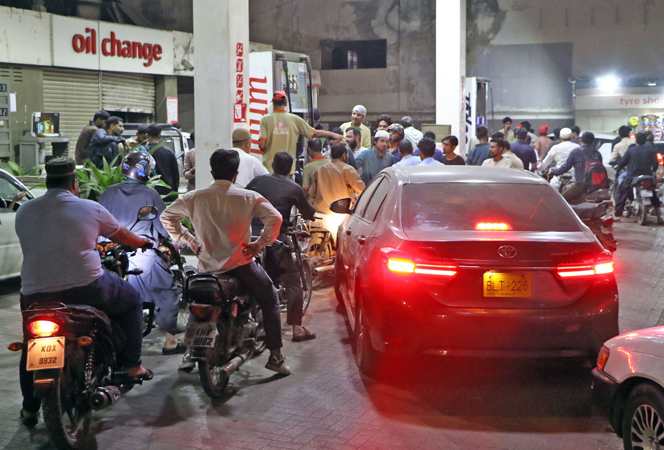
 The federal government has raised petrol prices by Rs55 per litre as surging global oil prices, fuelled by the US?Israel war with Iran, put pressure on domestic energy costs.
Following the increase, the price will now be sold at Rs321.17 per litre, while high-speed diesel will now cost Rs335.86 per litre across the country.
The announcement was made by Petroleum Minister Ali Pervaiz Malik in a press conference alongside DPM Ishar Dar and Finance Minister Muhammad Aurangzeb.
This marks the first weekly review of fuel prices since regional tensions threatened a major share of global energy flows following the closure of the Strait of Hormuz.
Previously, the federal government adjusted petroleum prices on a fortnightly basis.
US crude oil futures climbed more than 10% on Friday, pulling closer to Brent as buyers sought available barrels, with Middle Eastern supply constrained by the effective closure of the Strait of Hormuz amid the expanding US-Israeli conflict with Iran.
Brent crude futures were up $5.42, or 6.35%, at $90.83 a barrel at 10:37am. CST (1637 GMT). West Texas Intermediate crude (WTI) was up $7.81, or 9.81%, at $88.96.
It was the second straight day that gains in US crude futures had outpaced those in the Brent contract.
Dar said the government had remained in continuous engagement with all relevant ministries and energy-sector stakeholders throughout the day in an effort to reduce the burden on the public.
He said that the situation in the Middle East has seen no respite. Over the past week, he said his counterparts had held dozens of calls with him. Dar said Pakistan remained in active contact with Central Asian states and all countries in the Middle East.
“Pakistan is making every effort, in coordination with its partners, to de-escalate the conflict that is currently underway and to bring under control what has virtually become a war situation,” he added, noting that how long this process will take was known only to God.
Aurangzeb said the country was currently in a stable position in terms of macroeconomic indicators, adding that “our reserves place us on a solid footing.”
However, he added that “hope is not a strategy”, emphasising that the entire government must come together to undertake scenario planning and analysis. “The whole of government must adopt a proactive approach in this regard,” he said.
Earlier in the day, Prime Minister Shehbaz Sharif ordered an immediate nationwide crackdown on the hoarding of petroleum products, directing provincial governments to shut down petrol pumps and cancel the licences of those involved in creating artificial shortages.
Presiding over a high-level meeting to review the country’s fuel stocks amidst a shifting regional situation, the prime minister also mandated the creation of a real-time digital dashboard to monitor the movement and transportation of petroleum products across all provinces.
The prime minister directed provincial governments to take strict legal action against hoarders of petroleum products. “Any petrol pump involved in the heinous business of creating artificial shortages should be shut down immediately, its licence cancelled, and legal proceedings initiated,” he ordered.
PM Shehbaz directed the Minister for Petroleum to visit the provinces and, in collaboration with provincial governments, prepare a strategy and plan for the conservation of petroleum products and their uninterrupted supply to the public.
Separately, the government’s committee to monitor petrol prices on Friday submitted its recommendations on a work from home policy to Shehbaz Sharif, along with a comprehensive implementation plan covering fuel supply assurance, enforcement measures, pricing and governance mechanisms, and energy conservation steps.
A plan had been prepared to reduce working days for offices, educational institutions and service providers in order to conserve fuel.