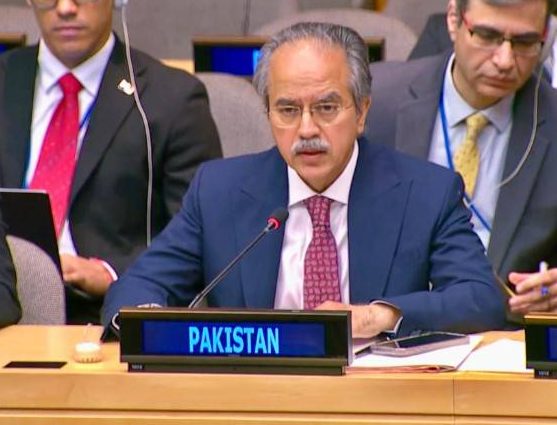
Pakistan has urged the international community to take urgent and coordinated steps to protect United Nations peacekeepers as emerging technologies rapidly transform modern conflict zones. Speaking at an event at UN Headquarters in New York, Ambassador Asim Iftikhar Ahmad warned that the growing use of drones and unmanned systems by hostile actors has made peacekeeping missions more complex, fluid, and increasingly lethal. He stressed that global responses must evolve just as quickly as the threats themselves.
As one of the largest contributors to UN peacekeeping missions, Pakistan highlighted the human cost behind these operations and the sacrifices made under the UN flag. Ambassador Ahmad noted that Pakistan has lost 182 peacekeepers while serving in some of the world’s most dangerous theatres, often under severe operational and logistical constraints. He emphasized that for troop- and police-contributing countries, the safety of personnel is not only strategic but deeply personal.
Read more : Pakistan warns UN peacekeeping at risk amid $1.57B funding shortfall
Moreover, the envoy pointed out that attacks against peacekeepers are rising in places such as South Sudan, the Central African Republic, the Democratic Republic of the Congo, and along the Blue Line monitored by UNIFIL between Lebanon and Israel. At the same time, mission resources and operational footprints are shrinking, which increases exposure and vulnerability on the ground. He warned that this imbalance between threats and capacities creates serious risks for personnel deployed in volatile regions.
In this context, he referred to a recent drone attack in Kadugli that killed six Bangladeshi peacekeepers, describing it as a clear example of how non-state actors now exploit advanced technologies. He explained that such attacks are difficult to trace, which weakens deterrence and complicates accountability efforts. Therefore, he stressed that holding perpetrators responsible must remain central to collective international action.
Read more : Pakistan warns UN funding crisis threatens global peace –
However, Ambassador Ahmad also described emerging technologies as a double-edged sword that increase risks but also offer potential solutions for force protection. He said counter-unmanned aircraft systems, improved early-warning mechanisms, enhanced surveillance tools, and data-driven threat analysis are no longer optional but essential. Ultimately, he concluded that peacekeeping mandates must be matched with adequate resources and capabilities to ensure that those serving under the UN flag receive the protection they deserve.