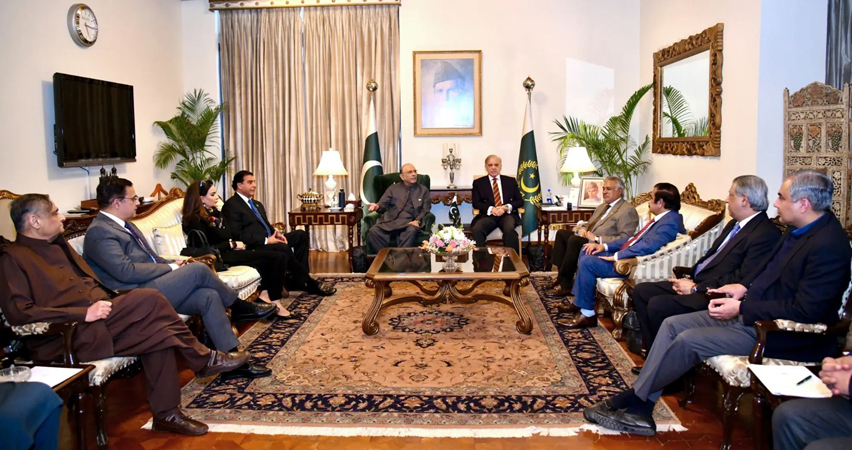
 President Asif Ali Zardari and Prime Minister Shehbaz Sharif on Wednesday reviewed the country’s overall political, economic and security landscape during a meeting at President’s House.
According to a statement issued by the President’s Secretariat (Media Wing), the prime minister called on the president and discussed the prevailing domestic situation as well as regional and global developments.
The two leaders exchanged views on key political matters and assessed the country’s economic trajectory amid ongoing reform efforts.
They also reviewed the internal security situation and deliberated on broader regional dynamics.
The meeting was attended by Deputy Prime Minister and Foreign Minister Senator Muhammad Ishaq Dar; Interior and Narcotics Control Minister Senator Syed Mohsin Raza Naqvi; Law and Justice Minister Senator Azam Nazeer Tarar; Economic Affairs Minister Senator Ahad Khan Cheema; Adviser to the Prime Minister Dr Syed Touqeer Hussain Shah; Adviser on Political Affairs Senator Rana Sanaullah; Senator Sherry Rehman; and Raja Pervez Ashraf, MNA.
No further details were shared about the deliberations.
Earlier, Foreign Office (FO) spokesperson Tahir Andrabi confirmed on Thursday that Prime Minister Shehbaz Sharif would attend the upcoming Board of Peace meeting in the US, saying that Deputy Prime Minister and Foreign Minister Ishaq Dar would also accompany him.
“I can confirm that the prime minister will attend the upcoming Board of Peace meeting. He will be accompanied by the deputy prime minister and foreign minister,” Andrabi said during a weekly briefing of the FO.
He added that information about other members of Pakistan’s delegation and its engagements would be shared in due course of time.
Responding to the question on Trump’s statement about the number of downed jets during war with India, the FO spokesperson said: “We have stated it previously, and I wish to reiterate it here that Pakistan is appreciative of the role of the United States during our 90-hour war with India.
The Foreign Office also urged Afghanistan to take decisive action against terror outfits operating from Afghan soil, stressing that while Pakistan sought peace and prosperity for Afghanistan, it would neither close the door to diplomacy nor escalate tensions into war.
“Diplomacy continues even in wars. Diplomacy continues even during skirmishes. So we would not shut the door of diplomacy, as much as we would not want to open the door of wars between our two brotherly countries. We wish peace and prosperity to our Afghan brothers and sisters. But we do not want their territory to be used against Pakistan,” said Foreign Office spokesperson Tahir Andrabi during his weekly press briefing.
On a question related to Defence Minister Khawaja Asif’s statement that Pakistan could strike inside Afghanistan before the month of Ramzan, Andrabi said, “The statement of Defence Minister Khawaja Asif reflects deep disappointment in Pakistan that Afghan authorities have not taken any action against the terrorists operating on their soil against Pakistan. In the context of this statement, the views of the defence minister are fully comprehensible.”
Andrabi referred to the latest United Nations Security Council (UNSC) report, which aligns with Pakistan’s narrative regarding the Tehreek-e-Taliban Pakistan (TTP) and Afghanistan. “The report corroborates Pakistan’s position that TTP resurgence is linked to the post-2021 interim government takeover,” Andrabi said. He added that the government would follow up with the UN Secretariat, the Security Council, and international stakeholders to address these issues.
During the session, the FO spokesperson was asked whether Pakistan’s decision to play the T20 World Cup match against India after announcing an initial boycott was the consequence of back-channel cricket diplomacy between the two sides.
In response, Andrabi said: “Cricket is a game that we all love and we all cherish. We grew up playing this game. Weaponisation of cricket, politicisation of cricket is regrettable.”
He explained that the government’s decision to not play against India “reflected the resolve of the government of Pakistan to not let cricket be weaponised and politicised”.
“Our subsequent decision to play reflected our magnanimity, after the relevant cricket authorities realised that they had weaponised and politicised cricket, particularly weaponised against Bangladesh.