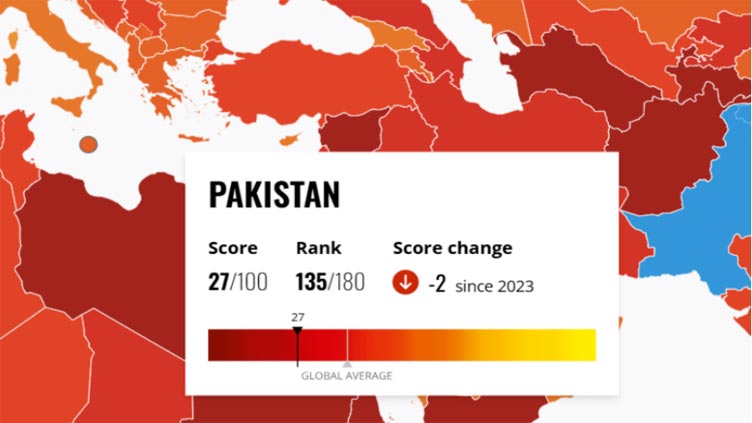
Pakistan has recorded a slight improvement in the Corruption Perceptions Index (CPI) 2025, with its score rising by one point and its global standing showing a marginal shift, according to Transparency International’s latest report released on Tuesday.
Pakistan’s CPI score increased from 27 in 2024 to 28 in 2025, reflecting a modest improvement in perceptions of public-sector corruption. However, its ranking moved from 135 out of 180 countries last year to 136 out of 182 countries in 2025, as more countries were included in the index.
Read More: Pakistan slips two spots on corruption index
Justice Zia Perwez, Chair of Transparency International Pakistan, acknowledged ongoing governance and institutional reform efforts but stressed the need for sustained action. He said effective implementation of the IMF Governance and Corruption Diagnostic Assessment recommendations is essential to maintain and accelerate Pakistan’s upward momentum in future CPI rankings.
Transparency International’s Corruption Perceptions Index (CPI) 2025 shows that Pakistan’s score has improved by one point to 28 compared to 2024. Additionally, Pakistan’s overall good governance score has increased in 2025, continuing an upward trend over the past four years.… pic.twitter.com/jorEqcz9ti
— Pakistan TV (@PakTVGlobal) February 10, 2026
The Berlin-based watchdog noted that corruption is worsening globally, with even established democracies experiencing declining performance. The 2025 index shows that only five countries scored above 80 this year, down from 12 a decade ago. Overall, 31 countries improved their scores since 2012, 50 declined, and 100 remained unchanged.
Denmark topped the index for the eighth consecutive year with a score of 89. In contrast, more than two-thirds of countries scored below 50, signalling serious corruption challenges worldwide. Somalia and South Sudan ranked at the bottom, each scoring just nine.
Read More: Pakistan ranking improved in global corruption index
The report also highlighted a troubling global trend linking declining CPI scores with shrinking civic space. Since 2012, 36 of the 50 countries that saw major drops in CPI scores also experienced restrictions on freedoms of expression, association, and assembly.
Transparency International emphasised that countries with strong democratic institutions, independent oversight, and protected civic freedoms tend to control corruption more effectively. It called on governments worldwide to strengthen justice systems, ensure transparency in political financing, protect media freedom, and safeguard civil society to counter corruption and restore public trust.