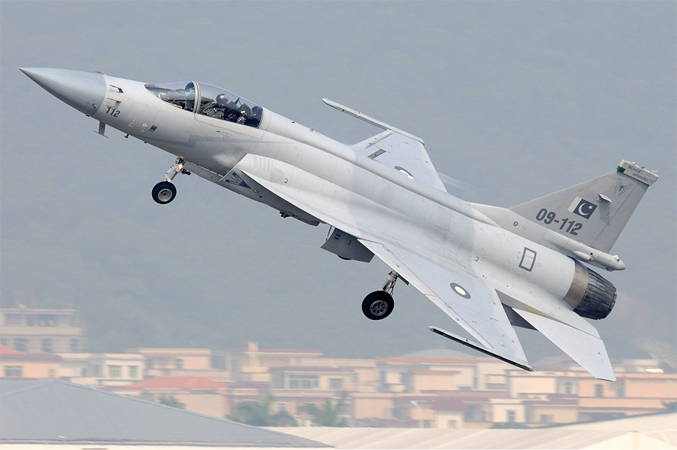
 In recent months, Pakistan has reported a surge in interest for its JF-17 fighter jet from five countries, a demand that may exceed the production capacity of its joint venture with China, Bloomberg said in a report.
The development comes as several countries have shown interest in acquiring the celebrated JF-17 fighter jet, which bolstered its prestige after demonstrating its capabilities in the May 2025 war against the neighbouring rival. The light combat aircraft is jointly developed by Pakistan and China and produced in Pakistan.
As per the Pakistan Armed Forces, Iraq, Bangladesh, and Indonesia have expressed interest in the JF-17 Thunder within the last month alone. Reuters separately reports that Saudi Arabia and Libya are also exploring the aircraft, following Pakistan lauded the Chinese-designed jet’s performance during the May 2025 conflict with India.
With a current production rate of fewer than 20 units annually-most of which are reserved for the Pakistan Air Force-this spike in demand presents a significant challenge. As Pakistan seeks to establish itself as an arms supplier for the developing world and a key partner in expanding Beijing’s global market influence, its manufacturing infrastructure may soon be pushed to its limits.
The JF-17 is seen “as a market disruptor due to its affordable price tag and, more importantly, its recent success in combat,” said Manoj Harjani, research fellow at the S Rajaratnam School of International Studies in Singapore. “Not hard to imagine the JF-17 becoming more widely adopted, especially by militaries that cannot afford fighters produced by Western companies.”
If Indonesia and Saudi Arabia end up purchasing JF-17s, it would represent a major shift, as both nations have long relied on more Western platforms. Indonesia recently took delivery of three Dassault Aviation SA Rafales as part of a defence deal with France, and it agreed with Boeing Co. in 2023 to buy 24 F-15 jets. Saudi Arabia similarly relies on US and European aircraft, and has sought to purchase F-35s.
It is pertinent to mention that Pakistan and Saudi Arabia have been in talks to convert about $2 billion of Saudi loans into a JF-17 fighter jet deal, deepening military cooperation months after the two nations signed a mutual defence pact last year.
Similarly, Pakistan also held detailed discussions with Bangladesh on the potential procurement of JF-17 fighter jets and Super Mushshak training aircraft.
Pakistan has also secured a $4 billion weapons pact with the Libyan National Army.
Moreover, a high-level Indonesian defence delegation met the Pakistan Air Chief to discuss strategic aviation cooperation, including the JF-17 Thunder fighter jet.
Conceived under a 1999 agreement, the JF-17 Thunder is a lightweight, all-weather multi-role fighter aircraft jointly developed by the Pakistan Aeronautical Complex (PAC) in Kamra and China’s AVIC Chengdu. According to former Air Commodore Khalid Chishti, Pakistan currently maintains a production rate of around 16 to 18 aircraft per year.
A primary competitive edge for the JF-17 is its affordability compared to Western counterparts. Speaking to BBC Urdu last month, Pakistan’s Minister for Defence Production, Raza Hayat Harraj, noted that the jet carries a price tag of $40 million to $50 million, depending on the specific variant and customisation requirements. This represents a significant cost advantage over platforms like the Dassault Rafale or Lockheed Martin’s F-16, which can exceed $100 million per unit.
Former Air Commodore Abbas Petiwala, speaking to Business Recorder last month, has said that the proven combat record, advanced capabilities and cost-effectiveness of the JF-17 Thunder have made the aircraft an attractive option for countries seeking modern fighter jets.
Petiwala said the first factor any country evaluates before purchasing a combat aircraft is its war record. “The war record of the JF-17 has been proven time and again,” he said, referring to the May 2025 clash with India during which, he claimed, the aircraft demonstrated its operational effectiveness.
Despite the relative affordability, the JF-17 has only so far been sold to Azerbaijan, Nigeria and Myanmar. Myanmar was the first buyer, ordering at least 16 Block IIs in 2015, with six delivered so far. Nigeria added three to its air force in 2021. Azerbaijan ordered 40 of the jets in 2024, in a deal worth about $1.6 billion. In November 2025, it unveiled five JF-17s at its Victory Day parade.
The recent interest, if translated into orders, requires a significant ramp-up of Pakistan’s and China’s production capacity. Libya and Bangladesh are both looking to buy 16 JF-17s each, reports say, while Saudi Arabia is possibly exploring a $2 billion deal with Pakistan for as many as 50. Indonesia is said to be in early discussions to acquire about 40 JF-17s.
With over 150 JF-17s in service, the PAF still needs to replace more than 250 aging Dassault Mirages and Chinese F-7s, a project expected to feature Chinese JF-17, J-10C, and FC-31 jets. And there are still 45 existing JF-17s export orders outstanding.
“So far it was like whatever Pakistan can make, the capacity was just enough for Pakistan,” said former Air Vice Marshal Faaiz Amir. “We had a long view for exports, but you don’t build capacity for exports before there are orders.”
Increasing production would require investment, and Pakistan might not have the funds for that, opined Sameer Lalwani, a senior fellow with the German Marshall Fund Indo-Pacific Program.