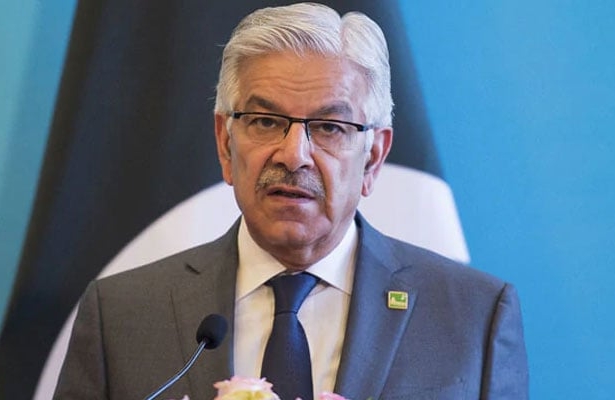
 Defence Minister Khawaja Asif on Monday claimed that the recent spike in violence in Balochistan is being driven by criminal networks whose “fake covers” of nationalism, politics and human rights movements have collapsed following a crackdown on oil smuggling.
“These groups no longer represent any political or ideological movement. What has emerged is a movement of criminals,” Asif said while addressing the National Assembly session, adding that the unrest was triggered by efforts to recover financial losses suffered by these networks.
He alleged that a well-organised corruption ring had been selling smuggled Iranian oil at inflated prices in Karachi.
“Oil being procured at around Rs60 per litre was sold for nearly Rs200 per litre. This network was earning approximately Rs4 billion in profits daily through oil smuggling, which has now been curbed,” he said.
“This is the reason peace has been disturbed in Balochistan.”
According to the defence minister, the situation has evolved into a nexus involving elements of the bureaucracy, tribal leadership and criminal groups. “It has turned into a complete nexus,” he remarked.
Highlighting the security challenges in the province, Asif noted that Balochistan is Pakistan’s largest province by area, with an extremely sparse population.
“There is roughly one person every 35 kilometres. Controlling such a vast area is far more difficult than managing a densely populated city,” he said, stressing the need for large-scale deployment of security forces.
“Our forces are deployed and are taking action, but there is a physical limitation when it comes to guarding and patrolling such an enormous area,” he added.
Asif further alleged that development funds allocated for Balochistan had been exploited by political leadership in collusion with bureaucratic elements.
Providing details of recent violence, the defence minister said that over a two-day period, 177 terrorists were killed, while 17 security personnel, including 10 police officers, six Frontier Corps personnel and one Levies official, were martyred.
He added that 33 civilians, mostly in Gwadar, also lost their lives during the same period. news desk
Separately, Prime Minister’s Adviser on Political Affairs Rana Sanaullah, addressing the Senate session, said that terrorists must be called terrorists without any “ifs or buts” and asserted that there was no sense of resentment in Balochistan.
Rejecting the impression of the lack of the government’s writ in the province, Sanaullah said that criminal activities could be carried out anywhere by a handful of groups acting together.
He added that even in secure areas, such groups sometimes take people hostage. In Balochistan, he noted, those involved in criminal acts stop buses and force passengers to disembark.
“They kill people from other provinces in front of their families and then go into hiding,” he said, referring to attacks such as those on the Jaffar Express. “What kind of grievance is this, that you murder innocent people?” he asked.
Sanaullah further questioned who had taken custody of the terrorists’ bodies when they were brought to a Quetta hospital after the Jaffar Express incident.
He alleged that these elements were acting against Pakistan at the behest of the enemy and stressed that action must be taken against them without any ambiguity.
Sanaullah added that the enemy had faced humiliation in the “Marka-e-Haq” and vowed that these terrorists would also be brought to the same fate.
Marka-e-Haq refers to the period of conflict with India from the April 22 Pahalgam attack to the May 10 conclusion of operation Bunyan-um-Marsoos.
Sanaullah was responding to queries raised by the Opposition Leader in Senate Allama Nasir Abbas over the security situation in Balochistan.
During the session, Senator Abbas criticised the government over its failure to maintain law and order in Balochistan, saying the state does not have writ across the province at night.
Abbas said the country was facing an economic, political, and law-and-order crisis and urged for the accountability of the people for lapses in security and oversight.
Senator Abbas noted that multiple cities of Balochistan had been targeted and that the attackers had sent a clear message to the world, signalling disillusionment with the state of affairs.
“Your duty is not to cry, it is to restore the writ of the state,” he said. He questioned whether the chief minister or interior minister had resigned over these failures. He concluded by emphasising the need to uphold the rule of law and criticised unelected representatives entering parliament. “We must engage in dialogue and bring everyone on board,” he said.
The upper house unanimously passed a resolution condemning terrorist attacks in Balochistan. The resolution was presented by Law Minister Azam Nazeer Tarar.