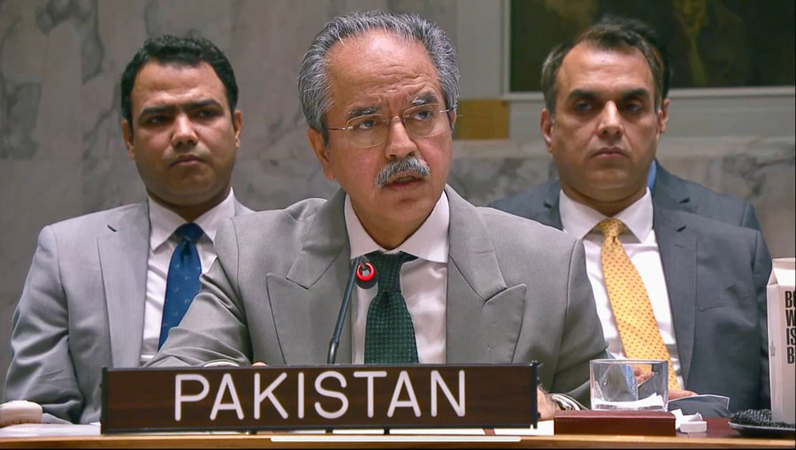
 Pakistan’s Permanent Representative to the United Nations Ambassador Asim Iftikhar Ahmad, highlighting the “exponential rise” in cross-border terrorist attacks from Afghanistan, has said that the situation has become “intolerable for Pakistan”.
His remarks come against the backdrop of a spate of coordinate attacks in Balochistan on Saturday. Clearing operations following the attacks continued on Sunday while Balochistan Chief Minister Sarfraz Bugti said in the afternoon that 145 militants had been killed within a span of 40 hours.
The military’s media affairs wing said the attacks were carried out by Fitna-al-Hindustan – a term that the state has designated for Balochistan-based terrorist groups to highlight India’s alleged role in terrorism and destabilisation across Pakistan.
Pakistan has also been raising alarm over the presence of terrorists in Afghanistan and accuses the Afghan Taliban of harbouring them. Islamabad has repeatedly urged Kabul to rein in terrorist outfits operating out of Afghanistan.
Speaking the media on Sunday, Ambassador Ahmad reiterated the accusation that the Afghan Taliban were sheltering militant groups operating against Pakistan and highlighted what he described as India’s long-standing support for proxy elements active from Afghan soil.
He said the UN secretary general had “quite rightly pointed out” earlier this week that the international community expected the Afghan Taliban to ensure Afghan soil was not used for cross-border terrorism.
The envoy noted that this commitment was central to the original Doha process but remained unfulfilled.
Under the Doha agreement in 2020, which paved the way for the US withdrawal from Afghanistan after 20 years, Kabul had committed to preventing militant groups from using its soil to threaten the security of the US, its allies and other countries.
A recent article in US-based magazine Foreign Affairs said that terrorist violence in Pakistan has surged since the Taliban returned to power in Afghanistan in 2021. It further described the Pakistan-Afghanistan border as “the most worrisome flashpoint in South Asia today.”
The magazine noted that the simmering conflict between Pakistan and Afghanistan now threatened to escalate, with potentially damaging consequences for the wider region.
Citing Pakistani research organisations, Foreign Affairs reported that 2025 was Pakistan’s deadliest year in a decade.
According to the Pakistan Institute for Conflict and Security Studies and the Pakistan Institute of Peace Studies, the country experienced a sharp rise in terrorist attacks, including by the banned Tehreek-i-Taliban Pakistan (TTP).
The magazine described the upward trend as deeply concerning and warned that Pakistan could face even deadlier attacks in the near future. The report highlighted that repeated mediation efforts – including talks facilitated by Qatar, Turkiye, and Saudi Arabia – have failed to secure a lasting Taliban commitment to rein in the TTP.
Cross-border strikes and retaliatory exchanges in recent months have further heightened tensions between Islamabad and Kabul, raising fears of a broader confrontation.
According to the article, the Taliban appear unwilling to take action against the TTP, which maintains close ideological and operational ties with the Afghan Taliban.
The magazine also suggested that the Afghan Taliban may be leveraging their confrontation with Pakistan for domestic political advantage, as defying Islamabad could bolster their legitimacy amid long-standing public resentment in their country.
Of particular concern for Pakistan is the Taliban’s growing engagement with India. Foreign Affairs warned that warming Taliban-India ties, coinciding with a surge in attacks inside Pakistan, could further complicate regional security dynamics.
Ambassador Ahmad pointed out that “the large presence of the TTP in Afghanistan, together with BLA (Balochistan Liberation Army) Fitna-al- Hindustan, and their terrorist acts against Pakistan from Afghan soil, have also been reported by the UN Monitoring Team.”
“There has been an exponential rise in terrorist attacks in recent years in Pakistan originating from across the border from Afghanistan,” he said, calling the situation “intolerable for Pakistan.”
Reiterating Pakistan’s resolve to respond decisively, he said: “We are taking all necessary steps to counter and eliminate this menace, and we are resolute in this objective.”
Pakistan attached particular importance to the Taliban’s pledge that Afghan soil would not be used for terrorism against other countries, the envoy said.
“This undertaking has not been fulfilled,” he said. “The Taliban have failed to do so.”
Ambassador Ahmad accused the Taliban authorities of complicity: “Not only have they failed to prevent these activities, they have sheltered, actively supported, and collaborated with these elements.”
He asserted that the terrorists also enjoyed “external support,” adding: “It is well known that India has all along supported these proxies working against Pakistan.”
He said concerns about Afghanistan had also been echoed by members of the Security Council. “There is broad recognition of the danger posed by terrorism emanating from Afghanistan,” he noted, adding that the country “unfortunately remains a terrorism hub under the Taliban,” a point raised by several council members during the most recent meeting on Afghanistan.