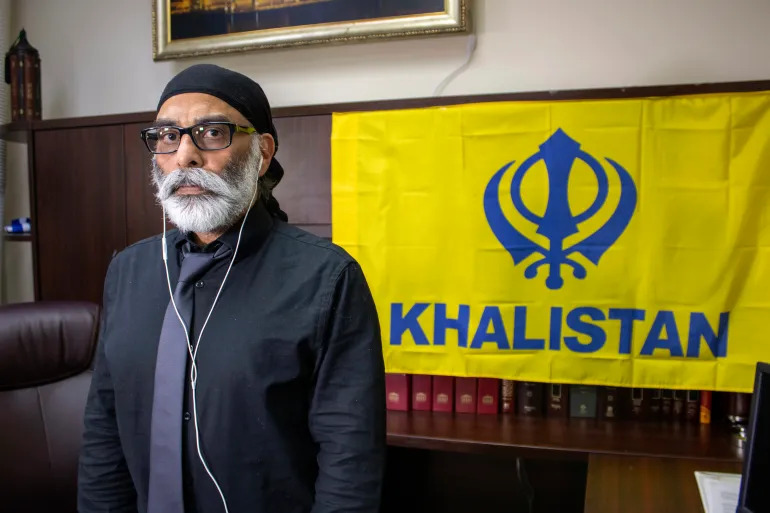
KARACHI / WASHINGTON — Sikhs For Justice, a group advocating a Sikh homeland, said it is ready to pledge $1 billion to join President Donald Trump’s proposed Board of Peace. The organization called on Trump to engage Indian Prime Minister Narendra Modi in talks to allow a Khalistan referendum in Indian-controlled Punjab under an international peace framework.
Addressing a press conference at the Karachi Press Club, SFJ said the proposed funding would back diplomatic efforts to avert a broader regional crisis. The group framed the initiative as a preventive step rather than a political confrontation.
“The Board of Peace provides a way to stop a deadly conflict before it erupts,” said Gurpatwant Singh Pannun, SFJ’s general counsel. He said the organization is prepared to commit one billion dollars to advance peace through dialogue.
Pannun described Punjab as strategically crucial, calling it the “Greenland of South Asia” due to its location and geopolitical importance. He said resolving the issue through a democratic process could stabilize South Asia, while ignoring it could heighten the risk of a major conflict.
SFJ warned that tensions in Punjab are escalating quickly. Referring to Indian government disclosures, the group claimed more than 8,000 Sikhs were detained in the past week amid mass arrests, alleged staged encounters, and terrorism-related cases linked to support for the Khalistan referendum.
“These developments are early warning signs of an emerging conflict,” Pannun said.
The organization said Sikhs represent a nation of over 30 million people with a distinct identity and political will. It argued that a negotiated referendum is the only realistic option to prevent further escalation. India has repeatedly rejected the idea of a Khalistan referendum, calling it a threat to its sovereignty and territorial integrity.
Placing the crisis in historical context, Pannun referred to the 1950 constitution’s classification of Sikhs as Hindus, the 1984 military operation at the Golden Temple, subsequent security crackdowns in Punjab, and the anti-Sikh violence of November 1984. He said these events triggered a decade-long insurgency and counterinsurgency that killed nearly 100,000 people.
“What started as genocide and econocide is now moving toward ethnic cleansing,” Pannun said, a characterization long disputed by the Indian government.
SFJ contrasted India’s regional posture with its own vision for Punjab, arguing that India poses nuclear and regional security risks to its neighbors. A peaceful, democratic Punjab, it said, could instead emerge as a U.S.-aligned partner contributing to stability in South Asia.
“The Sikh community is known worldwide for discipline, service, and dependability,” Pannun said. “A democratic Punjab could be a strategic ally that promotes peace, not conflict.”
The group stressed that its campaign is nonviolent and said more than two million Sikhs worldwide have taken part in what it calls the Khalistan referendum. However, Pannun warned that continued repression could drive instability.
“When votes are met with bullets, and political expression faces assassinations and mass detentions, violence becomes a real risk,” he said. “That is why we are offering $1 billion to join the Board of Peace, so talks can start now.”