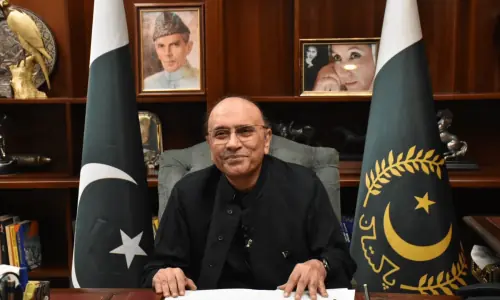
ISLAMABAD: President Asif Ali Zardari on Monday gave his assent to seven bills passed by parliament, including several that had earlier drawn controversy, turning them into law shortly before departing for an official visit to the United Arab Emirates (UAE).
Read More: President Zardari awards Nishan-e-Imtiaz to UAE naval chief
The president had last month returned the legislation unsigned after it was passed by both the Senate and the National Assembly. Following this, a joint sitting of parliament was convened, which reapproved key bills and sent them back to the presidency for assent.
According to a statement issued by the Presidency, the approved laws include the National Tariff Commission (Amendment) Bill, 2026; Export Development Fund (Amendment) Bill, 2026; Transfer of Railways (Amendment) Bill, 2026; Domestic Violence (Prevention and Protection) Bill, 2026; Daanish Schools Authority Bill, 2026; Income Tax (Amendment) Bill, 2026; and the National Commission for Human Rights (Amendment) Bill, 2026.
President @AAliZardari approves seven bills passed by the Parliament.
Read More: https://t.co/A3DI05kzPb pic.twitter.com/qQ6swqdJOD
— PPP (@MediaCellPPP) January 26, 2026
Among the most debated was the Domestic Violence Bill, which was introduced by PPP lawmaker Sharmila Faruqui but had faced opposition from the Jamiat Ulema-i-Islam (JUI-F). The National Commission for Human Rights Amendment Bill was also opposed by the same party. Additionally, the Daanish Schools Authority Bill had raised concerns within the Pakistan Peoples Party, which argued that education is a provincial subject and that the federal government should not establish a nationwide network of Daanish schools. These concerns were later addressed by the PML-N before the bill’s passage in the joint sitting.
Read More: Zardari set for key four-day UAE visit
After signing the legislation, President Zardari departed for the UAE on an official visit from January 26 to January 29, accompanied by a high-level delegation. During the visit, he is scheduled to hold meetings with the UAE leadership to review bilateral relations, with a focus on trade, economic cooperation, defence, security and people-to-people contacts. Discussions will also cover regional and international issues of mutual interest, according to the Foreign Office.