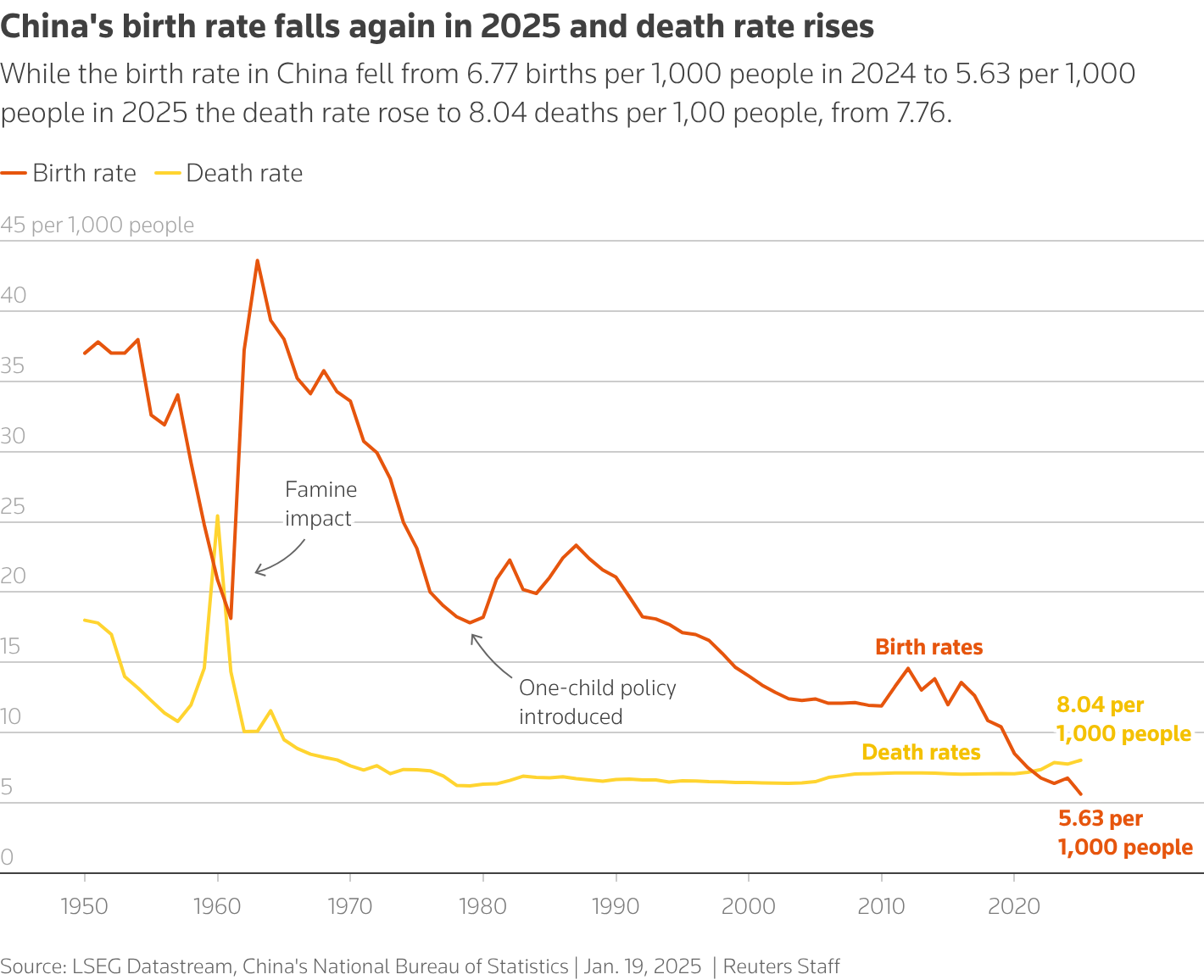
China’s population fell for a fourth straight year in 2025, dropping by 3.39 million to 1.405 billion, according to official data released by the National Bureau of Statistics (NBS). The total number of births fell sharply to 7.92 million, down 17% from 9.54 million in 2024, while deaths rose to 11.31 million, marking the highest death rate since 1968.
Read More: China’s birth-rate push struggles as couples choose child-free lifestyles
The country’s birth rate now stands at 5.63 per 1,000 people, a level comparable to 1738 when China’s population was around 150 million, according to demographer Yi Fuxian of the University of Wisconsin-Madison. China has experienced a shrinking and rapidly ageing population since 2022, complicating efforts to boost domestic consumption and manage rising debt.
BREAKING: China’s birth rate has fallen to a record low, the lowest since 1949. The country’s population declined for a fourth consecutive year in 2025, as annual deaths continued to outnumber births.
No New Humans = No Civilization pic.twitter.com/uC7fXuvnA5
— DogeDesigner (@cb_doge) January 19, 2026
People aged over 60 now make up around 23% of the population, and projections suggest this figure will reach 400 million by 2035—roughly equal to the combined populations of the United States and Italy. Beijing has already raised retirement ages, with men expected to work until 63 and women until 58, in an effort to offset workforce declines.
China’s long shadow of the one-child policy (1980–2015) continues to shape demographics. Marriages fell by a fifth in 2024, with only 6.1 million couples registering, though a policy change in May 2025 allowing couples to marry anywhere in the country helped temporarily boost unions by 22.5% in the third quarter. Authorities are promoting positive views on marriage and childbearing, alongside subsidies and full reimbursement of pregnancy-related medical expenses, including IVF, to encourage higher birth rates.
Read More: China population to begin shrinking by 2025
China’s fertility rate remains one of the lowest globally at about 1 birth per woman, far below the 2.1 replacement rate. Urbanisation has accelerated, with 68% of the population now living in cities, where raising children is costlier, further exacerbating demographic challenges.