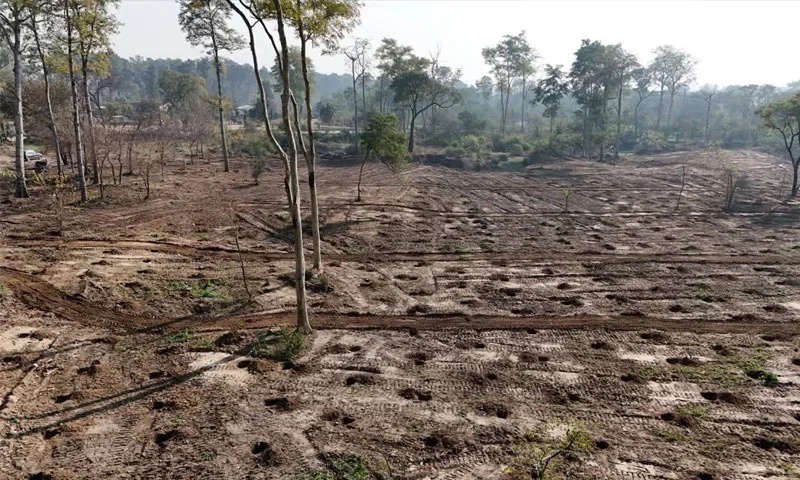
ISLAMABAD: The Pakistan Peoples Party (PPP) on Wednesday continued pressing the government over the large-scale felling of trees in Islamabad, expressing dissatisfaction with responses given in the National Assembly a day earlier.
Read More: Plant a tree, secure Pakistan’s tomorrow: President Zardari
PPP lawmaker Shazia Marri said the issue had been raised in the NA as “all parliamentarians were concerned,” but the answers from the state minister for interior had only raised further questions. She cited conflicting explanations, including pollen allergies and the notion of maintaining “brown” and “green” districts, and asked, “At what cost? At the cost of your environment? At the cost of urban planning?”
Marri also highlighted concerns raised by civil society, including the World Wide Fund for Pakistan (WWF-Pakistan), over the lack of transparency in the tree-felling exercise. She criticised the government for providing numbers of trees cut without proof of replantation, saying, “We don’t know how many trees are being planted — we are only told that these many thousands have been planted. But what proof is there of this?”
The lawmaker urged the government to be forthcoming with information, warning that public scrutiny would continue. “If there’s indeed purity in this action of yours, then share it. Tell us,” she said. Marri also noted the absence of a press conference by the government to explain the matter to the public.
The Capital Development Authority (CDA) has stated that only paper mulberry trees were removed due to pollen allergies, while Climate Change Minister Musadiq Malik defended the action, describing paper mulberry as an invasive and “life-threatening” species. Social media users, however, alleged that indigenous trees were also cut, leaving areas such as Shakarparian barren.
Read More: PM forms committee to strengthen climate resilience
At the press conference, Marri also criticised the state of load shedding and gas shortages in Sindh, questioning the government’s management of energy resources and highlighting the constitutional rights of residents in gas-producing regions.