 The sun of the new year 2026 has risen. Year 2025 has finally ended. 2025 will be remembered as the year of the “Pakistan Pivot.” After years of economic fragility and regional isolation, Pakistan has successfully leveraged its geostrategic location and military professionality to reclaim its status as a pivotal state. Under a unified civil-military vision, the nation transitioned from a debt-driven survival mode to a stability-driven growth model.

By the end of 2025, Pakistan has emerged not just as a survivor of crises, but as a disciplined regional leader with restored conventional deterrence and a cooling economy.
Military Diplomacy & Conventional Deterrence
The cornerstone of 2025’s success was the “Strategic Resurgence” led by the military leadership. The year saw Pakistan move from a defensive posture to a proactive, authoritative stance on the world stage.

Operation Bunyan-un-Marsoos:


In May 2025, following a “false flag” attempt in Pahalgam (Operation Sindoor), the Pakistan Armed Forces delivered a decisive response. This kinetic engagement re-established conventional deterrence with India and proved that Pakistan’s technological and tactical edge remains unmatched.
The PAK-KSA Defence Pact:

It was signed in September 2025, the Strategic Mutual Defence Agreement (SMDA) transformed a historical friendship into a formal security alliance. This pact- the first of its kind between an Arab power and a nuclear-armed state-positions Pakistan as a primary security stakeholder in the Gulf.

The US Reset:

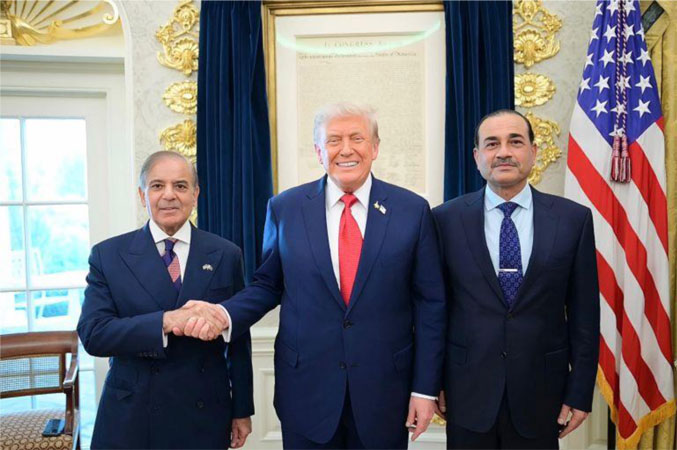
2025 marked a historic thaw in Pak-US relations. President Trump’s public recognition of Pakistan’s role in preventing regional escalation, coupled with the revival of the Counter-Terrorism Dialogue, has moved the relationship toward transactional mutual respect.

Economic Stabilization

While 2024 was a year of firefighting, 2025 became the year of The Great Cooling. The government’s adherence to structural reforms has yielded dividends that exceeded global expectations.

Inflation & Monetary Policy:

Headline inflation, which once peaked at over 30%, plummeted to a record low of 5-6% by late 2025. This allowed the State Bank of Pakistan to cut policy rates to 11%, re-igniting industrial activity and private investment.

The SIFC & CPEC 2.0:

The Special Investment Facilitation Council (SIFC) acted as a “one-stop shop,” securing billions in FDIs.
Concurrently, CPEC 2.0 (2025-2029) shifted focus from infrastructure to high-tech corridors, green energy, and the $6 trillion critical minerals sector.

Privatization Success:

The successful privatization of PIA for Rs135 billion and the auctioning of 5G licenses signaled to the global market that Pakistan is serious about reducing the state’s footprint in the economy.
Internal Security


The state’s approach to internal security shifted from containment to eradication. 2025 saw a decisive offensive against the Fitna-e-Khawarij (TTP) and Baloch separatist groups.

Dismantling the TTP Nexus:
Through Operation Azm-e-Istehkam, the state neutralized over 2000 terrorists in 2025.

By officially designating the TTP as Fitna-e-Khawarij, the state won the ideological battle, stripping the group of any religious legitimacy.

Assertiveness on the Western Border:

Pakistan ended the policy of strategic patience with Kabul. Retaliatory strikes against TTP sanctuaries in October 2025 sent a clear message to Taliban regime.
Afghan soil cannot be used as a launchpad for terror. This led to a significant decrease in cross-border incursions by the year’s end.
Neutralizing the BLA:

The U.S. designation of the Balochistan Liberation Army (BLA) as a Foreign Terrorist Organization (FTO) in August 2025 was a massive diplomatic win.
It crippled the BLA’s international funding and facilitated targeted intelligence-based operations (IBOs) that have severely degraded their Majeed Brigade.
Global Image & Multilateralism
Pakistan’s eighth term on the UN Security Council provided the perfect platform to project the narrative of being a Responsible State.
Gaza & Middle East Crisis:
Pakistan emerged as a leading voice for a ceasefire in Gaza. Its potential role in a regional peacekeeping force and its mediation between Iran and Saudi aligned interests have played an important role in the crisis of Middle East.
The Jaffar Capture:
The capture of the high-value terrorist involved in the Abbey Gate bombing was a gift to the global community, proving that Pakistan remains the most effective partner in the global war on terror.
2026 & Beyond
As we enter 2026, the Social Contract between the people and the state is under repair through economic relief and security gains. Pakistan has navigated the Year of Crises by turning every challenge into a strategic opportunity. With a stabilized rupee, a modernizing military, and an investment-ready landscape, the nation is no longer just holding on-it is leading.