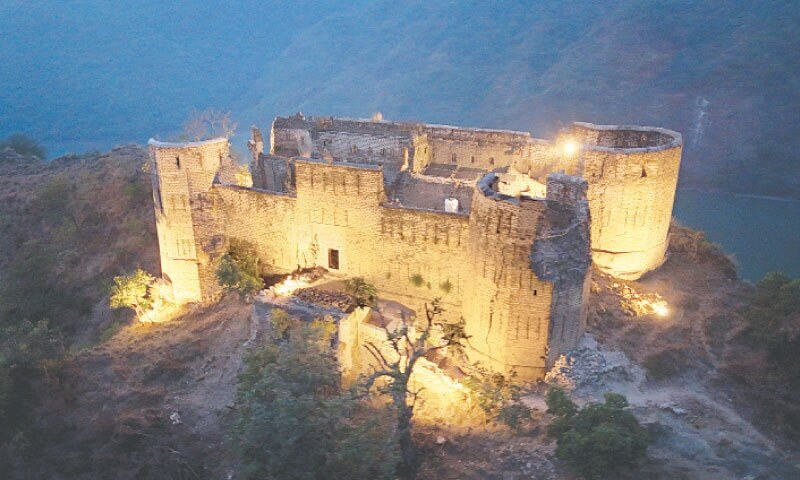
ISLAMABAD: Restoration work has begun on the more than 550-year-old Ain Fort in Rawalakot district, bringing renewed attention to a historic site that had long remained hidden under dense forest and decades of neglect.
Read More: How Akbar came to love books despite never learning to read
For the first time since the creation of Pakistan, the Himalayan Wildlife Foundation has launched a conservation project to stabilise and restore the ancient fort, which dates back to around 1460 AD. Historians believe it was originally built by the Shah Mir rulers of Kashmir, later fortified during the Mughal era after Emperor Akbar annexed Kashmir in 1587, and strengthened again during the Dogra period between 1858 and 1947.
Situated at the narrowest crossing point of the Jhelum River, Ain Fort once functioned as a customs, forest and military outpost. It formed part of a strategic chain of forts, including Baghsar, Mangla, Ramkot and Throchi, spaced roughly seven to 20 kilometres apart. Before restoration began, the structure was in a severely dilapidated condition and close to collapse.
According to Dr Anis Rehman of the Himalayan Wildlife Foundation, who is leading the project, conservation work began two months ago after nearly two years of procedural approvals. He said the site would remain open to visitors even as restoration continues, allowing tourists and students to observe traditional masonry techniques, including the preparation of lime mortar used over five centuries ago.
The project is being funded by the Pakistan Poverty Alleviation Fund in collaboration with the Azad Jammu and Kashmir government and the National University of Sciences and Technology (Nust), which is providing computer-based designs to help restore key archaeological features. Full restoration is expected to take another six months.
Read More: Welcome to the sunshine state — basking in Dubai’s winter warmth and taking to the skies
Dr Rehman said the process required careful management of vegetation, as trees and shrubs had grown into the walls over time. “Cutting trees without planning can cause walls to collapse. Our aim is to preserve the soul of the fort using traditional materials like stone and lime, while making it accessible for heritage tourism,” he added.