
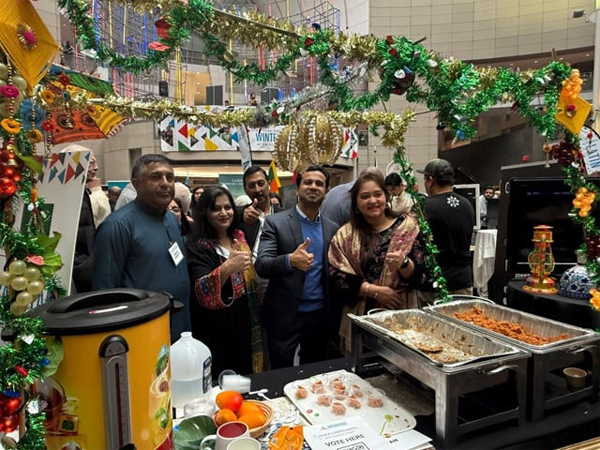
 For an evening this weekend, International Drive in Washington, D.C., resembled a neighbourhood in Lahore, as tables lined with kababs, biryani, gulab jamun and channa daal halwa set the scene at the annual Christmas dinner hosted by the Embassy of Pakistan.
The reception, held for the Pakistani-American Christian community and their friends, combined a Christmas gathering with cultural outreach. Inside the embassy’s main hall, red and gold Christmas lights framed the space, while Pakistan’s green featured prominently–from the flag outside the chancery to lapel pins worn by attendees.
Organised in collaboration with Virginia-based community group All Neighbours International, the event has become a regular fixture for the diaspora. For more than a decade, the embassy’s pre-Christmas reception has brought together Pakistanis of all faiths, Muslims, Christians, Hindus, Sikhs, local clergy and American well-wishers. Despite freezing temperatures, attendance remained strong, with families filling the hall throughout the evening.
The programme both opened and concluded with a spontaneous chant of “Pakistan Zindabad”, reflecting a shared sense of national attachment among members of the diaspora.
A special message from the Governor of Virginia commended one of the organisers, Ilyas Masih, for his decade-long role in community-building and his “commitment to service.” It was conveyed by the governor’s advisor, Dr Srilekha Palle, who said Mr Masih’s work had helped bring communities together across faith lines.
“Each person who seeks to serve others is a point of light that brightens the entire Commonwealth,” Dr Palle said.
She also expressed her hope to visit Pakistan in the future, remarking that patriotism and faith can be deeply intertwined.
“Loving one’s country is inseparable from faith itself,” she said. “To love your homeland is to reflect your love of God.”
Over time, the embassy’s Christmas reception has taken on a broader role as a platform for interfaith engagement. Participants included Pakistani-American Christian families, Muslim and minority community members, church leaders, and representatives from U.S. institutions. Pastor John Nuzum of the Church of the Holy Spirit offered prayers and Christmas greetings for the people of Pakistan and the United States, highlighting peace and goodwill across faiths. The presence of a representative from the Jewish-Islamic Dialogue Society of Washington further underscored the emphasis on sustained interfaith engagement and dialogue. At a time when political discourse in the United States and elsewhere has grown increasingly divisive, speakers noted that such gatherings offer space for conversation beyond partisan and ideological lines.
In her remarks, Deputy Ambassador Batool Kazim described the dinner as part of Pakistan’s inclusive national outlook. “This gathering is not just about Christmas,” she said. “It is about recognising our Christian citizens as an essential part of Pakistan’s national family and celebrating that bond together.”
She called interfaith harmony and pluralism integral to Pakistan’s national identity and referred to recent measures aimed at strengthening minority protections, including the establishment of the National Commission for Minority Rights. Referring to the role of Christians in national development, Kazim added: “The role Pakistani Christians (and members of other religions) have played in education, healthcare and public service is part of our shared history. It is something the country takes pride in.”
Speakers also noted that Pakistani Christians living abroad often play an informal role in connecting Pakistan with Western societies, sharing personal experiences that challenge misconceptions and broaden understanding.
The evening included a cultural performance by children, combining Pakistani elements with Christmas themes. Several attendees spoke about recent visits to Pakistan, describing positive interactions that shaped their understanding of the country beyond media narratives.
As the programme concluded, the chant rose again.
“Saying ‘Pakistan Zindabad’ here means something different,” a guest added quietly.