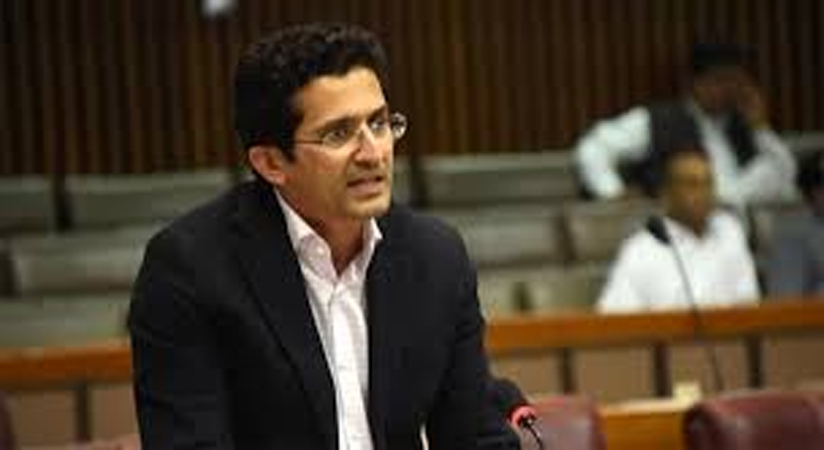
 Minister for Energy (Petroleum Division) Ali Pervaiz Malik on Monday apprised the National Assembly that that domestic gas supplies in current winter are significantly higher than last year adding that complaints are being addressed on a priority basis.
Responding to a calling attention notice raised by Ms Naeema Kishwer Khan, Mr Noor Alam Khan and others regarding prolonged load-shedding of sui gas in Khyber Pakhtunkhwa, particularly Mardan and adjoining areas, he said overall gas availability to household consumers on the Sui Northern Gas Pipelines Limited (SNGPL) network had improved. About 590 million cubic feet per day (MMCFD) gas is being supplied to domestic consumers this November as compared with last year of 460 MMCFD, showing an increase of roughly 26 per cent.
He said that Sui Southern Gas Company (SSGC) had also increased supplies to the domestic sector in its franchise area by around 18-20 per cent.
Ali Pervaiz Malik said Prime Minister Shehbaz Sharif was personally reviewing the gas situation and had held a dedicated meeting earlier in the day to ensure uninterrupted supply to household consumers during peak cooking and heating hours.
He said that the government’s clear policy was to prioritise domestic consumers, particularly between 5 pm and 10 pm, while managing overall system constraints during the winter season.
He informed the House that SNGPL had carried out network adjustments and rehabilitation work in localities including Gujar Ghari and Katlang (Mardan District) after issues of low pressure. The company had now reported normalisation of pressure in the area, he added.
The minister said SNGPL currently serves nearly seven to eight million domestic consumers, and in November around 90,000 complaints were lodged, of which 95-96 per cent were resolved within the 36-hour service-level benchmark prescribed by the Oil and Gas Regulatory Authority (OGRA).
He emphasised that local SNGPL teams remained in contact with elected representatives and were instructed to prioritize redressal of low-pressure and load-shedding complaints at the tail-end of the network.
Referring to queries regarding Balochistan, particularly Quetta, Ali Pervaiz Malik explained that the province’s winter demand rises from about 60 MMCFD in summer to nearly 170-180 MMCFD in peak season, which is higher than local production.
To bridge this gap, additional volumes are transported from Sindh, and the government has made arrangements for 20-30 MMCFD of extra gas for Quetta and surrounding areas. He acknowledged challenges such as gas theft and meter tampering, but said efforts were under way to strengthen enforcement while still protecting genuine domestic consumers.
Ali Pervaiz Malik assured the House that the Petroleum Division would continue to coordinate closely with the gas utilities to minimise hardship for consumers in Khyber Pakhtunkhwa, Balochistan and other regions during the winter months, and that Parliament would be kept fully informed about supply, demand and corrective measures.
Meanwhile, Minister for Finance and Revenue Muhammad Aurangzeb informed the National Assembly that Pakistan recorded a 27 percent increase in federal revenue collection last fiscal year, driven by structural reforms, digital monitoring of key sectors, and stricter enforcement against tax evasion.
Responding to a Calling Attention Notices raised by Syed Hafeezuddin and Muhammad Jawed Hanif Khan regarding rampant tax evasion and the devastating condition of revenue collection, the minister said the Federal Board of Revenue (FBR) collected Rs11.7 trillion compared to Rs9.2 trillion in the previous fiscal year-an unprecedented increase of nearly Rs5 trillion.
He said that withholding tax grew by 28%, sales tax by 26%, federal excise duty by 33%, and customs duty by 16%, terming the overall performance “strong and structurally driven rather than one-off.”
Aurangzeb said Pakistan’s tax-to-GDP ratio had already improved from 8.5% to 10.3%, and expressed confidence that it would reach 11% this year, supported by automation and technology-led reforms monitored weekly by the Prime Minister.
The minister informed the House that enforcement efforts were now focused on widening and deepening the tax net.
He said nearly Rs 200 billion was collected from retailers and wholesalers this year, with around 400,000 non-null returns filed-“a real compliance gain.”
He said digital production monitoring had already begun in the sugar and cement sectors, resulting in Rs7 billion and Rs10 billion additional collections respectively between July-November. “These reforms will continue. Technology is the equalizer,” he said, urging Syed Hafeezuddin and other members to share intelligence on suspected evasion so enforcement could be further tightened.
Aurangzeb also acknowledged a point raised earlier by Minister for National Food Security Rana Tanveer Hussain regarding access to finance in agriculture.
He highlighted that the government had launched a collateral-free loan programme for farmers holding less than five acres and engaged in subsistence-level livestock farming.
He said the first-loss guarantee and subsidy would be provided by the Government of Pakistan through the State Bank, and the scheme had already been operationalised.
Responding to various supplementary questions, Aurangzeb said he had already clarified Pakistan’s position on the IMF Governance Diagnostic Report on the floor of the Senate, but was reiterating it for the Lower House.
He said the report was based on input from 100+ meetings involving 30+ departments, and that IMF had explicitly acknowledged Pakistan’s progress in several areas-including fiscal performance, primary surplus, inflation moderation, reserves building, State Bank strengthening, FATF exit, digitalisation reforms, and alternative dispute resolution mechanisms.
Aurangzeb emphasised that the report’s 15 recommendations were technical in nature and not a judgment on any government or administration.
He said that Pakistan was required to submit its action plan by 31 December, and that the plan would be made public and shared with the Standing Committee on Finance.