 The government stressed on Monday that the imposition of governor’s rule in a province is an option provided by the Constitution, even as Khyber Pakhtunkhwa Chief Minister Sohail Afridi dared the Centre to impose the measure.
The federal government is seriously considering imposing governor’s rule in KP, citing “security and governance issues” in the province as the reason for this potential move.
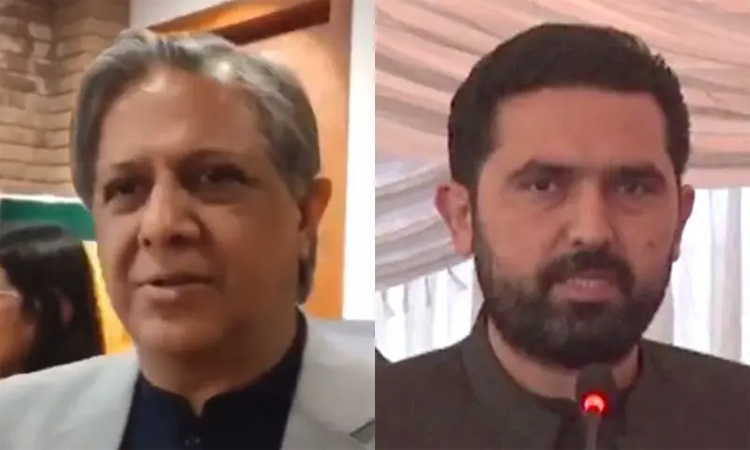
“Governor’s rule is not the face of any martial law. It is provided for in the Constitution by its creators,” said Law Minister Azam Nazeer Tarar while speaking at the National Assembly.
He argued that if the conditions merit it, then it was within the Constitution to implement it.
Similarly, Information Minister Attaullah Tarar also told reporters, “It is a constitutional option that is available to every government, so such discussions arise when governance is weak. Let’s see how matters proceed.”
On the other hand, CM Afridi dared the federal government to impose governor’s rule in KP.
“We are not afraid of governor’s rule. If they are so bold, then let them try and impose it,” he said while talking to the media in Peshawar.
Questioned about the law and order situation in the province, he responded: “Those who have implemented policies [framed behind] closed doors should realise this.”
CM Afridi assailed the federal government for not giving the province its due share of finances, saying the provincial government was taking positive measures in various sectors with its own available resources.
Addressing an event in Peshawar, he said over Rs3,000 billion were owed to KP by the Centre. “Just imagine what we will be able to do if that amount is given to the KP government and people. Discriminatory treatment is being done to us,” the chief minister added.
Afridi also slammed the federal government over the scale of institutional corruption highlighted in the recent International Monetary Fund (IMF) report.
Speaking in the National Assembly, PTI MNA Asad Qaiser criticised the treasury benches for suggesting the imposition of governor’s rule, saying the federal government had adopted an “undemocratic attitude”.
“If the government is thinking about governor’s rule, then do whatever you want, but you know you won’t be able to handle its political repercussions,” Qaiser warned.
Meanwhile, PTI Chairman Barrister Ali Gohar ruled out any notion of governor’s rule being implemented in KP.
Questioned about the issue outside Parliament House, Barrister Gohar said the situation would improve and ruled out the possibility of governor’s rule.
“I don’t at all see it. Neither are the conditions there, nor will there ever be. People should not engage in rumour-mongering and the province cannot bear governor’s rule.”
He added that the province was beset by terrorism and the PTI government would strive to eliminate it and improve law and order, adding that CM Afridi should be given time.
“Hopefully governor’s rule will not be implemented and the province will be run as per the law and the Constitution,” Gohar said.
When asked about the protest call in KP todayagainst the denial of meetings with Imran, Gohar said it had been almost a month since the last meeting with the PTI founder, and claimed that he was being kept in isolation.
“He is the people’s leader and he has representation in Parliament, so this is very wrong, and there should be meetings so matters can be streamlined.”
Separately, Law Minister Azam Nazeer Tarar said on Monday that the government would issue the notification appointing Chief of the Army Staff Field Marshal Asim Munir as the country’s first chief of defence forces (CDF) in the coming days, adding that he was already “holding the office in all respects”.
The CDF position, created under the 27th Constitutional Amendment, replaced the now-abolished office of the Chairman Joint Chiefs of Staff Committee (CJCSC), which formally ended on November 27. It will be a dual-hatted position combined with the office of the army chief.
“The PM is out of the country right now, so once he returns, everything should happen,” he added. “Maybe the paperwork will be completed by then.”
Prime Minister Shehbaz Sharif is currently on a visit to London and, according to Information Minister Attaullah Tarar, is expected to return today.
The law minister further explained that notifying the new CDF is the defence ministry’s job, and they have to coordinate with the PM’s office.
Another pending decision is the appointment of the commander of the National Strategic Command, a new four-star position created to assume the nuclear manager role previously exercised by the CJCSC. Officials believe this appointment will be made only after the CDF notification is issued.
Meanwhile, the National Command Authority (NCA) Act still requires amendment to reflect the abolition of the CJCSC and the emergence of the CDF and NSC commander under Article 243.