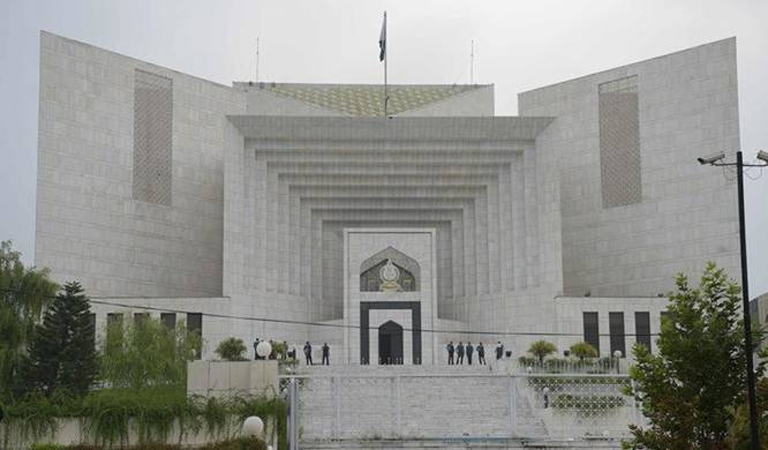
 The Supreme Court of Pakistan has dismissed petitions filed by three police officials from Dera Ghazi Khan against their dismissal from service, ruling that illegal detention, torture and endangering the lives of citizens constitute “grave misconduct” in the police force and cannot be condoned.
According to the court’s officially approved detailed judgment on Friday, a three-member bench comprising Justice Aminuddin Khan, Justice Jamal Khan Mandokhail, and Justice Naeem Akhtar Afghan heard the petitions filed by Head Constable Khalid Mehmood and Constables Riaz Hussain and Safdar Ali against the decision of the Punjab Service Tribunal.
The petitioners were accused of illegally detaining a citizen, Zaryab Khan, from June 18 to 23, 2020, without any FIR or arrest warrant, and subjecting him to torture, which later led to his death. Although the officials were acquitted in the criminal case by giving them the benefit of the doubt, a departmental inquiry found them guilty of corruption and abuse of authority.
After completing the inquiry and hearing the officials, the Regional Police Officer (RPO) of DG Khan deemed the initial recommendation of reducing their salaries insufficient and enhanced the penalty to dismissal from service. The decision was upheld first in departmental appeals and later by the Punjab Service Tribunal.
In its ruling, the Supreme Court stated that the Constitution guarantees the dignity, liberty, and fundamental rights of citizens, and acts of illegal detention and torture by police personnel violate these constitutional protections while also undermining public trust. The court further held that acquittal in a criminal case does not nullify departmental proceedings.
The bench noted that the petitioners failed to raise any legal question warranting review or interference; therefore their leave-to-appeal petitions were dismissed.
Land Dispute
The Supreme Court of Pakistan has ruled that a land-grab dispute does not end with the death of the accused, directing the Peshawar High Court to re-adjudicate the matter in accordance with the law.
According to the court’s officially approved detailed judgment for reporting, the Supreme Court partially set aside the Peshawar High Court’s Abbottabad Bench ruling dated March 21, 2022, and ordered a fresh examination of the question of restoring possession of the disputed land.
Justice Ahsan Ishtiaq Ibrahim authored the judgment on behalf of the three-member bench, observing that illegal occupation of land is a matter that does not conclude with a criminal conviction, as its civil consequences continue. Therefore, even after the death of the accused, the appeal regarding restoration of possession remains maintainable.
The complainant, Advocate Muhammad Khurshid Khan, had filed a case under the Illegal Dispossession Act, 2005, alleging unlawful occupation of his 11-marla property. In 2015, the trial court sentenced the accused, Dost Muhammad Khan, to three years in prison but released him on probation due to his age and health, while also directing him to return possession of the land within one month. Four co-accused were acquitted.
During the pendency of the appeal, Dost Muhammad Khan passed away, resulting in the automatic abatement of the appeal against the prison sentence. However, the Supreme Court held that the issue of restoring possession remains alive under the law and cannot be ignored.
The apex court noted that the 2005 Act is a special law that provides landowners with immediate protection and an effective mechanism for reclaiming possession. While criminal proceedings abate upon an accused’s death, this principle does not apply to civil consequences such as restoration of possession. Under the law, the order to vacate the land can be enforced against the deceased’s legal heirs or any person claiming through him.
The Supreme Court instructed the High Court to hear the legal heirs of the deceased and re-examine the question of possession. It upheld the plea seeking enhancement of the sentence but set aside the portion of the High Court’s judgment relating to restoration of possession, remanding that part of the case back to the Peshawar High Court for fresh consideration.
Private Power Firm
The Supreme Court of Pakistan has upheld the Islamabad High Court’s 2013 ruling ordering the federal government to return a performance guarantee worth Rs 33 million, along with profit, to the private power company Spencer Powergen in a long-running dispute over a power project support agreement.
According to the officially approved detailed judgment issued for reporting here Friday, Justice Mian Gul Hassan Aurangzeb authored the order on behalf of the three-member bench, which also included Justice Munib Akhtar and Justice Muhammad Shafi Siddiqui.
Court records show that in 1994 the government issued a Letter of Support to the company for establishing a 330-megawatt private power plant. However, in 1996, amid concerns of electricity overproduction, the Economic Coordination Committee (ECC) decided that once the national capacity target of 3,000 megawatts was achieved, the bank guarantees of remaining power projects would be encashed.
The Supreme Court observed that under a corrective decision issued by the Cabinet Division on July 3, 1996, all power projects holding a valid Letter of Support as of April 15, 1996, were entitled to the return of their performance guarantees if they failed to achieve financial close-on the condition that they refrained from initiating further legal action against the government or related institutions.
The judgment noted that a 1997 report prepared by the Ministry of Water and Power-submitted by the government itself before the court-confirmed that Spencer Powergen was eligible for reimbursement under this policy.
The Supreme Court held that the High Court had merely ordered the return of the performance guarantee, which did not interfere with any contractual rights but instead ensured implementation of the ECC’s decision. The bench therefore upheld the High Court’s directive requiring the Power and Water Division and the Private Power and Infrastructure Board (PPIB) to repay the amount to the company.