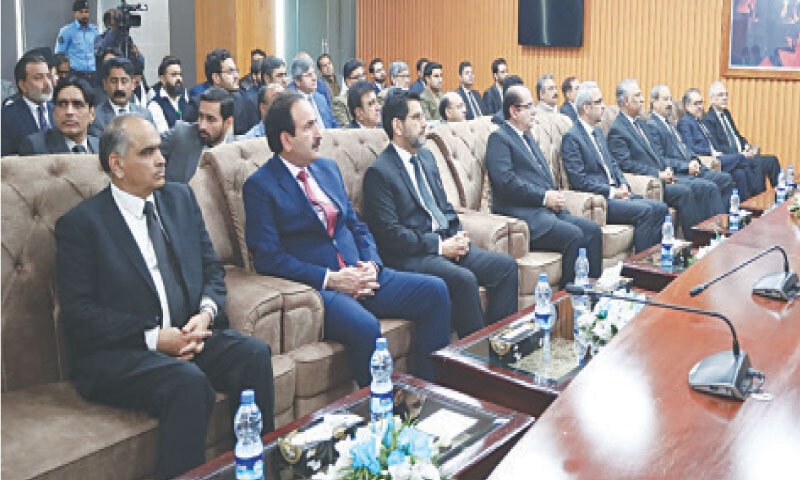
ISLAMABAD: The inauguration of the newly-formed Federal Constitutional Court (FCC) at the Islamabad High Court (IHC) building has sparked calls to relocate the court to its originally designated premises in the Federal Shariat Court (FSC) building. The dispute over control of Constitution Avenue premises has drawn attention from the legal community and policymakers alike.
The Islamabad High Court Bar Association (IHCBA) has demanded that the FCC be shifted out of the IHC temporarily, arguing that the Shariat Court building is the proper and permanent home. The bar has warned that any attempt to relocate the IHC itself will face legal and democratic resistance, citing concerns over space, infrastructure, and institutional precedence.
Read More: FCC CJ pledges to uphold constitution
The decision to assign the FSC building to the FCC followed the 27th Constitutional Amendment, which reintroduced the FCC after it was initially removed from the 26th Amendment package.
Interior Ministry officials had finalised the FSC building for the FCC, but the Shariat Court administration resisted the handover. FSC Chief Justice Iqbal Hameedur Rehman raised objections, arguing that vacating the purpose-built building within a week was abrupt and impractical.
Temporary arrangements at the IHC have led to cramped conditions. Oath-taking ceremonies for the FCC judges were held in small conference rooms or open spaces, while only seven courtrooms were made available for the FCC’s operations. Space allocation has created unease among senior IHC officials, who fear the highest constitutional forum may indirectly assert influence over the High Court premises.
Read More: FCC adopts SC rules as tensions rise over shared IHC premises
The bar remains divided on the issue. IHCBA President Wajid Ali Gilani reiterated that the FCC’s use of the IHC building must remain temporary and advocated for its relocation to the FSC, where infrastructure and caseload are suitable.
Conversely, the Islamabad Bar Association (IBA) welcomed the shift, citing practical benefits for lawyers, litigants, and access to justice in Sector G-10. The ongoing tug-of-war highlights planning challenges, administrative disputes, and competing interests between Islamabad’s legal institutions, with resolution yet to be achieved.