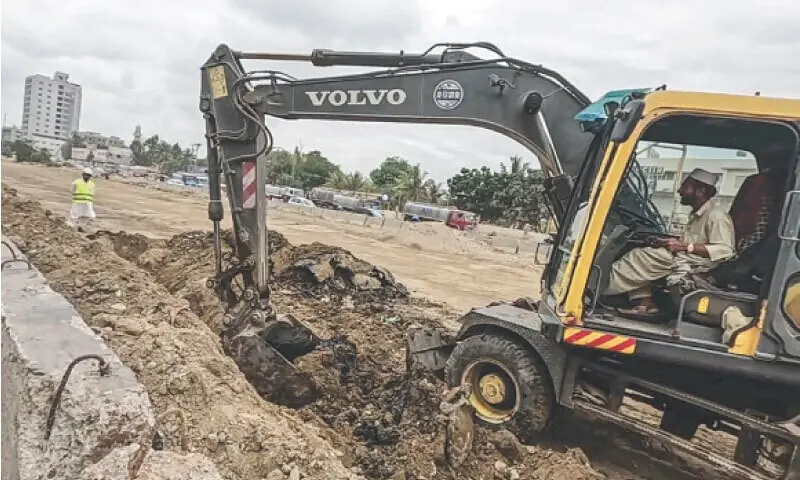
KARACHI: Construction work on the long-delayed Red Line Bus Rapid Transit (BRT) project has resumed after nearly two months of suspension, following the intervention of the Sindh chief minister. However, despite renewed assurances, no clear timeline for completion has been shared, leaving thousands of daily commuters along University Road to continue facing severe inconvenience.
The work had stalled due to rising project costs, disputes over underground utilities and coordination gaps among implementing agencies. Senior Minister Sharjeel Inam Memon informed an Asian Development Bank (ADB) delegation on Thursday that the bottlenecks had been addressed and that the provincial government remained committed to accelerating progress on the project.
Read More: ADB delegation reviews work on Red Line BRT project
Originally announced in 2017 with an estimated cost of Rs79 billion, the 27-kilometre BRT corridor from Malir Halt to Numaish has seen repeated delays and cost escalations. After work began in early 2022, completion was first expected in 2023, then moved to 2024 and now extended to late 2026. Many stakeholders consider even the latest target unrealistic, citing slow progress, contractor disputes, rising construction costs, land acquisition challenges and weak inter-agency coordination.
In a meeting with Chief Minister Murad Ali Shah at CM House, the visiting ADB team — led by country director Emma Fan — reviewed the performance of ADB-funded projects, including the Red Line. The delegation appreciated the province’s renewed efforts but stressed the need for improved institutional capacity, timely safeguards compliance and stronger performance benchmarks. ADB also expressed willingness to consider loan extensions and additional financing if progress continues steadily.
Read More: Memon reviews progress on red line, yellow line BRT projects
The chief minister reiterated his government’s commitment to fast-tracking priority projects in transport, climate resilience, infrastructure and water supply. Both sides agreed to maintain close coordination in the coming months, particularly regarding financing needs, restructuring options and improved mechanisms for community grievance redressal.