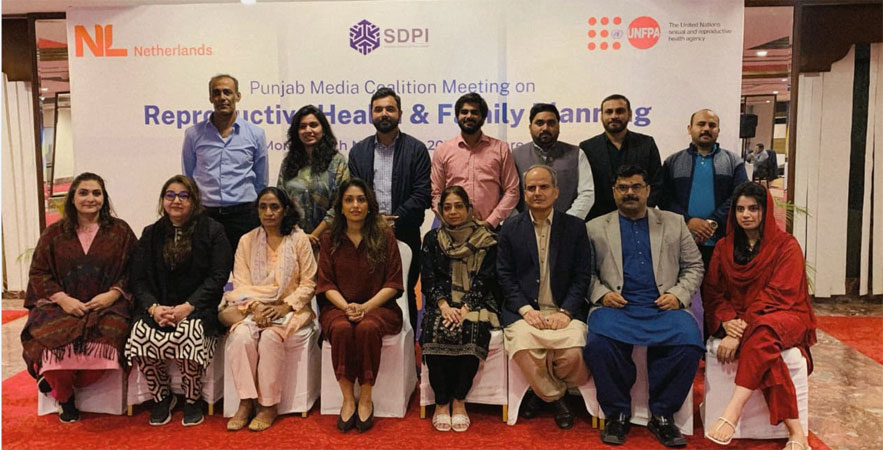
 A UNFPA-led initiative, funded by the Embassy of the Netherlands and implemented by the Sustainable Development Policy Institute (SDPI) on Monday brought together journalists from print, electronic, digital and social media platforms in Lahore to strengthen responsible media practices on gender-based violence (GBV), reproductive health (RH), and family planning (FP).
At the Punjab Media Coalition Meeting, UNFPA Provincial Programme Coordinator Tania Durrani said the session was the third in an ongoing series designed to equip media with clearer standards. She thanked the Government of Netherlands and SDPI for their support and noted that early coalition meetings had already helped define TORs for collaborative work. Citing recent sensationalized cases in Punjab, she stressed the need for ethical coverage: “These examples show why we need platforms that build capacity for accurate, responsible reporting on SRH and FP.”
She added that UNFPA is handing over newly developed study material through USB drives to support journalists as key partners in amplifying public-interest messaging.
SDPI Deputy Executive Director Dr Sajid Amin Javed underscored how the shift from print to electronic and now social media has eroded editorial rigor. “Speed has overtaken accuracy, and social media thrives on sensationalism, especially when covering GBV,” he said. The coalition’s goal, he added, is to promote responsive journalism and strengthen media as a catalyst for addressing violence in society.
UNFPA Communications Specialist, Mariyam Nawaz highlighted that GBV reporting requires exceptional care regardless of whether victims are women, men or transgender persons. She said irresponsible coverage had bred mistrust and restricted access to accurate information. “It’s unfair to focus on the victim rather than the issue,” she noted, stressing that 60-70% of audiences now consume news through digital platforms with minimal editorial oversight.
Strategic communication and social media expert Abrar ul Hassan spoke on ethical digital practices, emphasizing the importance of respectful thumbnails, non-graphic visuals, balanced text and avoiding sexualization. He urged training on safe and responsible use of AI, warning that improper practices can harm both victims and audiences.
The meeting also included a group exercise in which journalists revised a sample story to remove sensational and propagative language, replacing it with more responsible, ethical framing.
Hasna Batool, Technical Specialist-SRH, UNFPA in her vote of thanks said the media role in rising news speed and rating race are bound to ensure ethical bindings and norms while reporting on critical issues like GBV and SRH.
The group work was precisely designed that motivated and enlightened the media persons who participated in the Coalition meeting, she added. She welcomed all participants to share their feedback and suggestions for improving responsible reporting on GBV and SRH.