 Afghanis are renowned for their extraordinary bravery, resilience and profound sense of dignity honed by centuries of standing against foreign empires and internal strife. Yet, this noble spirit has been tragically overshadowed by a history of internal discord and exploitation by external factors, often rendering the nation a pawn in the geopolitical Great Game. Allama Muhammad Iqbal recognized this inherent potential and the deep-seated tragedy of the Afghan condition. His poignant call to self-awareness encapsulated in the verse, “Apni Khudi Pehchan…O Ghaafil Afghan” (Understand your Self, O Heedless Afghan) rings true today. This “heedlessness” is not by the Afghan people, but of the regime in Kabul that has deepened the country’s isolation and threatened regional stability by consistently reneging on its commitments. Now, once again it is sacrificing the nation’s future for an exclusionary, militant ideology.
The Deceitful Path

The Afghan Taliban secured significant international concessions through a series of written and verbal commitments, foremost among them the Doha Accord of 2020 with the United States and a subsequent trilateral agreement with the Pakistan and UAEin 2024.

The core bargain was straightforward: engagement in an inclusive intra-Afghan political dialogue and an ironclad guarantee to prevent the use of Afghan soil against other nations. However, the Taliban’s actions since regaining control in August 2021 have proven them to be deeply deceitful, utilizing these agreements as a means to gain financial benefits and political legitimacy without ever intending to fulfill their side of the bargain.
The Collapse of Intra-Afghan Dialogue & Societal Exclusion

The first critical failure lies in the complete abandonment of the Intra-Afghan dialogues, a cornerstone of the Doha Agreement. This phase was intended to find a political solution to the internal conflict and was predicated on the release of 5,000 Taliban prisoners. The agreement stipulated that these released individuals would not rejoin militancy. In reality, most of the released prisoners immediately returned to fighting, and instead of engaging in dialogue with the then-Ashraf Ghani government, the Taliban intensified their insurgency, culminating in the swift march on Kabul.

Post-takeover, the Taliban 2.0 regime has embraced the same exclusionary and obscurantist policies of its predecessor. The most visible victims are women and girls, who have been systematically stripped of their fundamental rights. This includes the effective banning of female education beyond a certain grade and preventing women from working in most sectors, a direct contradiction of initial verbal assurances of moderation and respect for women’s rights within the framework of Islamic law.

Furthermore, the structure of the current Taliban government is entirely anachronistic and non representative. The cabinet is composed overwhelmingly of ex-militant commanders, almost entirely from the Pashtun ethnic group. While Afghanistan is home to at least 14 recognized ethnic groups-with Pashtuns making up an estimated 42%, Tajiks 27%, Uzbeks 9%, and Hazaras 8%-the governance structure lacks genuine pluralism. The 49 member cabinet, including the Prime Minister, contains only a token representation of other groups. Key ministries are exclusively held by Pashtuns. Crucially, every single member of the cabinet and the ideologically and politically directing Kandhar Shura were members of the militant Tehreek e Taliban Afghanistan before the takeover. This exclusive political makeup, dominated by one ethnic group and one rigid ideological faction, fundamentally violates the spirit of “intra-Afghan dialogue” and guarantees internal instability.

Afghanistan as a Terror Hub
The second, and perhaps most grievous, violation concerns the explicit stipulation in the Doha Agreement that the Taliban would not allow the use of Afghan soil by individuals or groups threatening the security of other countries. The documented facts overwhelmingly demonstrate a wholesale breach of this commitment, turning Afghanistan into a fortified haven for transnational terrorist organizations.
Protection of Al-Qaeda & TTP
Concrete evidence of this failure is abundant, often sourced from international monitoring bodies and intelligence reports: The leader of Al-Qaeda, Ayman al Zawahiri, was killed in an August 2022 US drone strike in Kabul, a full year after the Taliban took control. His presence in the capital was a direct violation of the Doha agreement and a clear indication of the Taliban’s continued association with Al-Qaeda.

The 35th UN Monitoring Team Report (Feb 2025) highlighted Saif al Adl’s strategy to reorganize Al-Qaeda and reactivate sleeper cells globally. The 36th UN Monitoring Report (2025) specifically outlined the Taliban regime’s support for the Tehreek-i-Taliban Pakistan (TTP) and Al-Qaeda, confirming that the General Directorate of Intelligence (GDI) provided three guest houses in Kabul for TTP leaders, issued them movement passes and weapon permits, and granted them immunity from arrest. The 66th Quarterly Report of SIGAR (Jan 2025) quoted UN estimates of 6,000 6,500 TTP fighters in Afghanistan, alongside 12 senior leaders of Al-Qaeda. The 68th SIGAR Report (Jul 2025) confirmed that the Taliban are providing safe havens not only to Al-Qaeda and TTP but also to ISIS-Khorasan (ISIS-K).
The Failure of the Trilateral Agreement
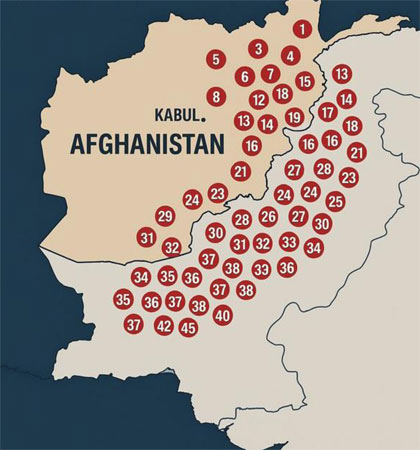
In an attempt to address the escalating cross-border threat, a trilateral agreement in 2024 was signed between Pakistan, UAE, and the Afghan Taliban. The Taliban agreed to relocate TTP terrorists away from border areas and stop their infiltration into Pakistan, securing sufficient funds from the UAE for this purpose. This agreement, too, was broken. Only a few hundred TTP members were relocated, with no mechanism to monitor their subsequent militant activities and no lists of those moved shared with either Pakistan or the UAE. The consequences of this breach have been borne by Pakistan: Between April and September 2025, Pakistani security forces killed 135 Afghan nationals in counter-terror operations. The Taliban government’s subsequent request for the retrieval of these bodies constituted an unprecedented, albeit tacit, admission of Afghan involvement in terrorism inside Pakistan. Pakistan has formally identified 58 terrorist camps being operated by TTP and BLA inside Afghanistan with the full knowledge and support of the Kabul regime.

Moreover, an estimated USD 7 billion worth of NATO weapons and equipment left behind has made its way to anti-Pakistan proxies and other terrorist organizations, significantly enhancing their combat potential.
The Global Consensus
The claim that Afghanistan under the Taliban has become a hub for transnational terrorist groups is not a political accusation-it is an official acknowledgment from major world powers and international organizations. Recent official statements underscore this global consensus:
8 Joint Quadrilateral Statement (Russia, China, Iran, Sep 2025) Confirmed that groups like ISIS, Al-Qaeda, Pakistani Taliban, and Jaish al-Adl are using Afghanistan as a base of operations.
8 Moscow Format (Oct 2025) Emphasized “The need to prevent the use of Afghan territory by terrorist groups.”
8 SCO (China, Sep 2025) Called on the Taliban to take measures to prevent the training and financing of terrorism within Afghanistan.
8 Russia (Lavrov Statement, Aug 2025) Stated, “Thousands of ISIS and other fighters are based inside Afghanistan, posing a threat to regional security.”
8 Collective Security Treaty Organization (Oct 2025) Noted that the “concentration of extremist elements in northern Afghanistan has become a source of regional instability.”
In addition to supporting terrorist entities, the Taliban regime is also actively suppressing internal dissent and freedom of expression. The UNAMA Media Freedom Report noted 256 instances of arbitrary arrests of journalists and media workers, 130 instances of torture, and 75 instances of threats/intimidation, showcasing an authoritarian clampdown.
The Path Forward
The Afghan Taliban’s systematic failure to honor the Doha Accord, the trilateral agreement, and countless verbal promises is not a sign of administrative weakness, but of a calculated strategy to secure international funding-including an estimated USD 80 million per month from the US and funds from UN donor agencies-while simultaneously pursuing an exclusionary, militant, and internationally hostile agenda. Disturbingly, reports suggest that funds intended for UN donor assistance are being routed to the TTP under the guise of refugee aid. By prioritizing an exclusive ethno-sectarian government, systematically oppressing women and non-Pashtun groups, and offering tangible protection and resources to major transnational terrorist organizations, the Taliban regime has effectively rendered Afghanistan an isolated state that actively endangers regional and global security. The international community, having repeatedly extended goodwill and diplomatic efforts- including four Foreign Minister visits, two Defence Minister/DG ISI-led missions, and 836 Protest Notes from Pakistan alone since 2021-must now shift from engagement to enforcement. It is imperative that the global community holds the Taliban regime accountable to their unequivocal commitments. Should the regime continue to demonstrate bad faith and fail to dismantle the terrorist infrastructure operating on Afghan soil, punitive measures must be applied to compel a genuine change in behavior before the region descends further into instability.