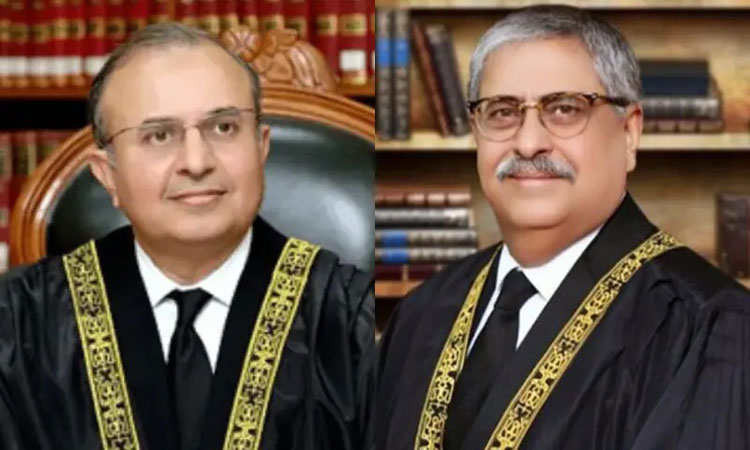
 Supreme Court Justices Mansoor Ali Shah and Athar Minallah handed in their resignations, hours after the contentious 27th Constitutional Amendment was signed into law by President Asif Ali Zardari on Thursday.
Both judges had called on Chief Justice of Pakistan Yahya Afridi in separate letters to summon a full court meeting and judicial conference to hold a debate on the 27th Constitutional Amendment.
In his latest letter to the president, Justice Shah assailed the amendment as “a grave assault on the Constitution of Pakistan”, which “dismantles the Supreme Court of Pakistan, subjugates the judiciary to executive control, and strikes at the very heart of our constitutional democracy”.
“By fracturing the unity of the nation’s apex court, it has crippled judicial independence and integrity, pushing the country back by decades,” he wrote.
“As history bears witness, such a disfigurement of the constitutional order is unsustainable and will, in time, be reversed – but not before leaving deep institutional scars.”
The judge stated that he had a choice between serving as an SC justice, which he said “undermines the very foundation of the institution one has sworn to protect”, or hand in his resignation.
“Staying on would not only amount to silent acquiescence in a constitutional wrong, but would also mean continuing to sit in a court whose constitutional voice has been muted,” Justice Shah wrote.
“Unlike the 26th Amendment – when the Supreme Court of Pakistan still retained the jurisdiction to examine and answer the constitutional questions – the present amendment has stripped this court of that fundamental and critical jurisdiction and authority.
“Serving in such a truncated and diminished court, I cannot protect the Constitution, nor can I even judicially examine the amendment that has disfigured it,” he stated.
On the other hand, Justice Minallah stated in his letter that when he took the oath of office 11 years ago, he swore to uphold not “a constitution” but “the Constitution”.
He wrote: “Prior to the passage of the 27th Amendment, I wrote to the Chief Justice of Pakistan, expressing concern over what its proposed features meant for our constitutional order.
“I need not reproduce the detailed contents of that letter, but suffice it to say that, against a canvas of selective silence and inaction, those fears have now come to be,” he added.
Justice Minallah regretted that the Constitution he swore to uphold was “no more”, adding that he “can think of no greater assault on its memory than to pretend that, as new foundations are now laid, they rest upon anything other than its grave”.
“What is left of it is a mere shadow; one that breathes neither its spirit, nor speaks the words of the people to whom it belongs,” the judge wrote.
“These robes we wear are more than mere ornaments. They are to serve as a reminder of that most noble trust bestowed upon those fortunate enough to don them,” the letter read. “Instead, throughout our history, they have too often stood as symbols of betrayal through silence and complicity alike.”
Separately, former attorney general of Pakistan Makhdoom Ali Khan tendered his resignation from the Law and Justice Commission of Pakistan to CJP Afridi.
“When you sought my consent to be a member of the commission, I accepted without a second thought.
“The Constitution, by then, had been amended for the 26th time. I could see despondence on the once shining faces of promising young lawyers. I continued to believe, however, albeit without cause, that it remained possible to negotiate the bends and avoid a free fall. The realists cautioned that I was out of touch. “The habits of a lifetime take time to die, however. These made me think that with technique, with finesse and with reason, persuasion will find a way. Advocacy will break through. The institution though battered and holed had not keeled over. And while it was afloat so was hope. It would of course require advocacy beyond ability which was possible given the extraordinary motivation. It always is,” he said.
However, he said the 27th Constitutional Amendment had “sunk that ship”. He added, “It has scuttled whatever was left of an independent judiciary. That being so, I cannot continue to be a member of an institution erected on the promise to reform the law. No law reform is possible or can be effective without an independent judiciary. To continue in these circumstances would be to perpetuate the worst fraud possible: a fraud on oneself. I can go on but that would serve no purpose … I, therefore, thank you for the opportunity but confess my inability to continue. I resign.”