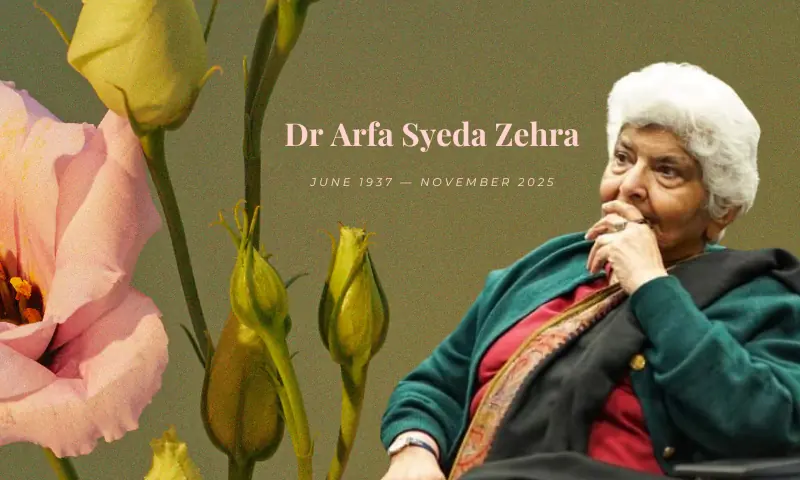
ISLAMABAD – Dr Arfa Sayeda Zehra, the renowned scholar and educator, recently highlighted the state of Urdu and broader sociocultural conditions in Pakistan, offering a sharp critique of how the country’s education system and societal pressures shape the younger generation. In an interview, she noted, “Aj ki nasal Urdu parh nahi paati, likh nahi paati, magar sunti hai to lutf leti hai” [Today’s generation cannot read or write Urdu, but they take pleasure in listening to it]. Her observation reflects not only linguistic decay but also a wider behavioural and cognitive shift.
Dr Zehra described the generational gap between language and expression, noting that while students can speak Urdu and enjoy its cadence, they rarely engage with it in writing. She argued that postcolonial conditioning has led English to become the language of ambition and employability, while Urdu remains a language of affection. This hierarchy reinforces a culture where practical utility is valued over emotional or creative literacy.

Beyond language, Dr Zehra warned of the psychological impact of economic pressures and social conditioning. She invoked the concept of “learned helplessness,” explaining how structural constraints on Pakistan’s lower- and middle-class populations limit their ability to pursue art, literature, and leisure. In a society that prioritises measurable productivity, imaginative and reflective pursuits are often deprioritised, leaving individuals cognitively and emotionally narrowed.
Read More: Pakistan mourns educationist Dr. Arfa Sayeda Zehra
She also critiqued the educational system, asserting that it prioritises efficiency, survival, and competition over cultivating sensitive and intelligent citizens. According to Dr Zehra, the system trains students to optimise every act for output, leaving little room for imagination, creativity, or human connection. Her reflections stress the importance of creating spaces — both physical and psychological — for the unmeasurable, deeply human aspects of life.
In conclusion, Dr Zehra’s insights call for a reconsideration of cultural, educational, and social priorities. She urges a move away from purely transactional approaches to life and learning, advocating instead for a society that nurtures intellect, sensitivity, and imagination alongside ambition.
Read More: Renowned scholar Dr Arfa Sayeda Zehra passes away