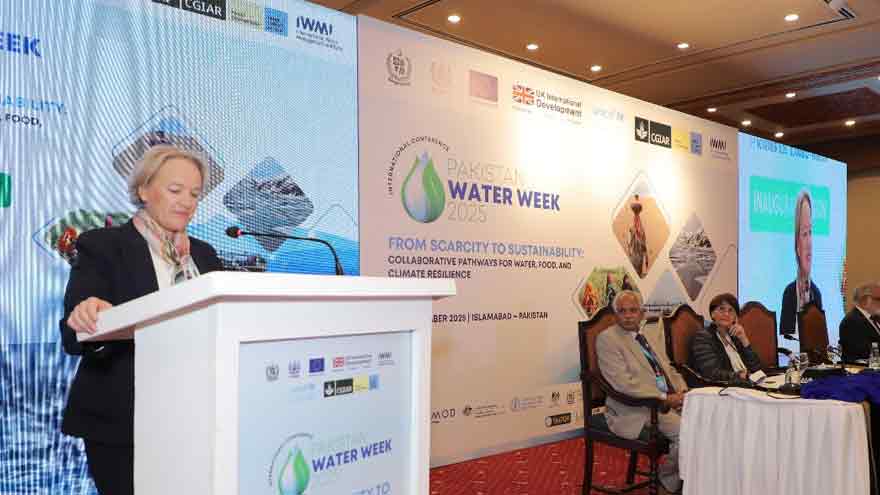
ISLAMABAD – Experts have warned that Pakistan cannot achieve real resilience unless water, food, and climate are tackled collectively rather than as separate sectors. They shared these views during the opening session of Pakistan Water Week 2025, which began in Islamabad on Tuesday.
Themed “From Scarcity to Sustainability: Collaborative Pathways for Water, Food, and Climate Resilience,” the event brings together scientists, academics, policymakers, and international partners to develop integrated strategies for sustainable resource management.
The conference is organised by the International Water Management Institute (IWMI) Pakistan in collaboration with PCRWR, CGIAR Policy Innovations, CGIAR Climate Action, and supported by the European Union (EU), FCDO, UNICEF, and ICIMOD.
Read More: UN warns Pakistan floods could trigger food crisis
Speaking as the chief guest, former irrigation and finance minister Muhammad Mohsin Khan Leghari highlighted that Pakistan is already witnessing the impacts of climate change through extreme droughts and devastating floods. “Water remains politically under-prioritised and fragmented in climate negotiations,” he said. “Collaboration is the force multiplier that turns scarcity into sustainability.”
In her keynote address, IWMI Deputy Director General Dr Rachael McDonnell said the conference comes at a critical time, following the June floods that killed over 1,000 people and affected nearly seven million. “The water crisis is a climate crisis,” she emphasised, calling for water to be placed at the centre of COP processes and global climate negotiations. She noted that Pakistan now has only 900 cubic metres of water per person, underscoring the urgency for reform.
Read More: NDMA warns of drier-than-usual winter across Pakistan
Meanwhile, IWMI Pakistan Director Dr Mohsin Hafeez warned that the country’s rising population is putting severe pressure on fragile water systems. With agriculture and urban demand rapidly outpacing available resources, he cautioned that Pakistan is moving from “water-stressed” to “water-scarce.” Dr Hafeez urged for innovative, collective action to ensure water security as a national priority.