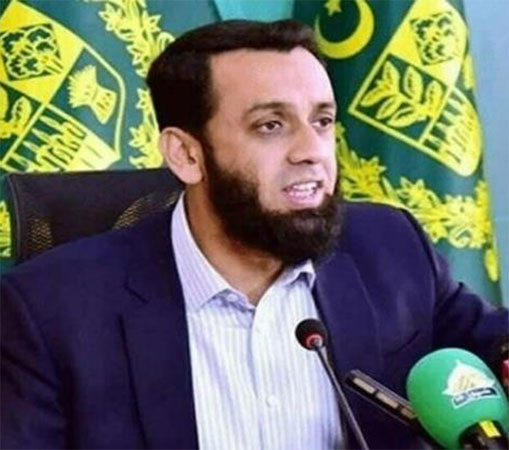
 Information Minister Attaullah Tarar on Sunday said that with the establishment of a joint monitoring and verification mechanism, the onus would be on Kabul to take action against terrorists using Afghan soil to launch attacks on Pakistan.
A second round of discussions between Pakistani and Afghan Taliban delegations had begun in Istanbul on Saturday, but Islamabad’s long-standing concern over terror attacks emanating from Kabul remained a major point of contention, resulting in a stalemate. A breakthrough came after Turkiye and Qatar salvaged the dialogue process for the second time in less than a week, following Pakistan’s announcement on Wednesday that the talks had “failed” and that its negotiators were preparing to return home.
The talks produced a three-point understanding – the continuation of the ceasefire, the establishment of a monitoring and verification mechanism to ensure peace, and penalties for violations. The operational details of that mechanism are expected to be finalised when the “principals”, senior representatives from both sides, meet again in Istanbul on November 6.
Speaking to a private TV channel, the information minister responded to a question about the monitoring mechanism discussed in Istanbul, stating that a review would be taken of activities during the past few days and modalities on a joint mechanism would be discussed.
“The onus is on the Afghan regime because their soil is being used for terrorism in Pakistan by Fitna-al-Khawarij and Fitna-al-Hindustan,” he explained. “For Pakistan, this will be an additional forum to provide evidence and the Afghan Taliban regime has to take action. If they do not take action, they will receive punishment.”
Fitna-al-Khawarij is a term the state uses for terrorists belonging to the banned Tehreek-i-Taliban Pakistan, while Balochistan-based groups have been designated Fitna-al-Hindustan to highlight India’s alleged role in terrorism and destabilisation across Pakistan.
When asked if Pakistan would respond to terrorist attacks by striking targets in Afghanistan after the mechanism is in place, Tarar said it would depend on the situation.
“If the situation is very serious and Pakistan has the right to retaliate within international law and the UN Charter, then it depends on the situation that arises,” he responded.
“Once the mechanism is established, there is joint verification and evidence is produced, then any party violating the agreement will be punished. But it depends on the situation,” he added. “Now the Afghan Taliban has no room to make excuses like they used to do. Now that third parties are involved, they will have to take action.”
In response to a question about Afghanistan’s offer to hand over terror suspects to Pakistan, Tarar explained that Pakistan’s government had declined the offer and questioned why the Afghan Taliban administration was issuing such statements following the talks.
“The matter is clear: Pakistan has previously demanded that any terrorists who pose a threat to Pakistan be controlled or arrested,” he said. “However, the Afghan side says they are Pakistani nationals and they will be handed over … I believe these new claims are twisting facts. We immediately proposed a handover through a border post; it is a long-standing position.
“I don’t understand why they have to give these statements and complicate the situation.”
Tarar also called the Afghan Taliban government a “fractured regime” which does not have complete control of Afghanistan.
“There are fragments and not every faction is under control. There is unity of thought between the civilian and military leadership [in Pakistan] and they (the Afghan Taliban) should stop levelling allegations at us. This is propaganda, to which we gave a befitting response.”
Separately, Tarar said there is no ambiguity about the May 9 attack on Radio Pakistan as everyone witnessed the arson and chaos.
In a statement issued from the federal capital, Atta Tarar said that Khyber Pakhtunkhwa Chief Minister Sohail Afridi should understand that mere political statements will not suffice – he bears the responsibility of an entire province.
He added that PM Shehbaz Sharif told Afridi that the federal government was ready to cooperate with him, but the CM did not even attend a high-level meeting on the national situation.
Responding to a question about the inquiry into the May 9 incidents, the Minister for Information and Broadcasting said that an inquiry is needed only where there is ambiguity.
Meanwhile, the repatriation of Afghan refugees continues at a rapid pace, as around 5,220 Afghan nationals returned to their homeland after reopening of the Torkham border, authorities informed on Sunday.
As per the data, 401 individuals returned through legal channels, while 2,314 were undocumented.
So far, over 828,000 Afghan refugees have completed their repatriation process.
The return process from other provinces is also ongoing. On the same day, 19 refugees departed from Islamabad and 450 from Punjab through Torkham Border, bringing the total number of returnees from various provinces to 25,392.
From KP transit points, 19 Afghan citizens were deported, while 7,261 detainees have been repatriated from jails in Peshawar, Landi Kotal, and Kohat.
As per the latest figures, more than 54,000 legal and 628,000 undocumented Afghan refugees have returned to Afghanistan since the start of the repatriation campaign.