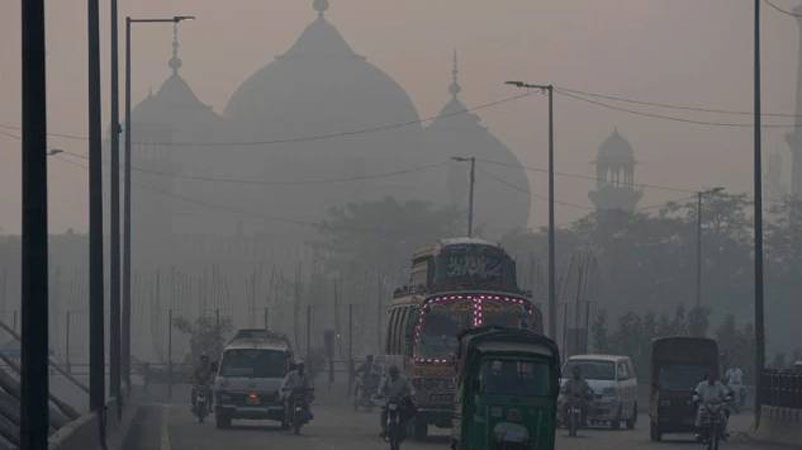
 Polluted winds blowing from the Indian regions of Haryana, Ludhiana, Patiala, and Jalandhar have entered Pakistan, significantly affecting the air quality in Lahore, Faisalabad, Kasur, and Gujranwala.
According to the Environmental Protection Department, the accumulation of smog and fine particulate matter in the atmosphere has intensified pollution levels.
Slow wind speeds ranging from one to six miles per hour are trapping polluted particles close to the ground, while temperature inversion is causing these pollutants to remain suspended in the air.
Air quality in Lahore has reached unhealthy levels, with the pollution peaking during early morning, late evening, and nighttime hours.
Officials predict Lahore’s Air Quality Index (AQI) to remain between 330 and 370, indicating hazardous conditions.
Although a slight improvement is expected during the afternoon hours between 1 pm and 5 pm, the overall air quality is likely to remain poor.
The Smog Monitoring and Forecasting System alarmed that the current wind pattern in Punjab is moving from east to west, carrying polluted air from across the border.
Environmental authorities have advised the public, particularly children, the elderly, and those with respiratory conditions, to avoid unnecessary outdoor activities.
Under the directives of Punjab Chief Minister Maryam Nawaz, anti-smog enforcement efforts have been intensified.
Authorities have issued over 10,000 notices under the zero-tolerance policy against stubble burning, while more than 190 factories and brick kilns have been inspected, resulting in dozens of closures and heavy fines.
Over 1,200 monitoring teams are actively ensuring strict compliance with dust control Standard Operating Procedures (SOPs) at construction sites across the province.
Meanwhile, the Punjab government is facing criticism and allegations of data manipulation after climate analysts and social media users accused the Environment Protection & Climate Change Department (EPCCD) of deliberately shutting down air quality monitoring stations in Lahore during peak pollution hours.
The controversy erupted when climate and public policy analyst Dawar Hameed Butt posted a series of tweets on X, alleging that the EPCCD had turned off several monitoring stations, particularly those in the more polluted northern and eastern parts of the city.
“EPCCD Punjab has turned off Monitoring Stations in Lahore,” Butt tweeted. “The ones left on are still ‘Beyond Index’. These are PAS officers, PhDs and ‘educated’ staff, and they think closing their eyes will solve the problem. Absolute failure unfolding now.”
He supported his claims with screenshots from the official government website, aqipunjab.com, which showed that data from multiple stations had not been updated for hours, still displaying readings from October 30.
The allegations were echoed by another social media user, Hassan Aftab, who suggested a “strategic motive behind the alleged shutdowns.”
“Punjab government’s new air quality strategy: if pollution levels look bad, just turn off the monitors. [Eight] out of 10 monitors are shut beyond 10pm in Lahore (when air quality dips further) to lower the average. Lahore now breathing the cleaner air (on paper),” he tweeted.
Aftab tagged Senior Minister Marriyum Aurangzeb, urging transparency. “Let’s ensure there’s uninterrupted data from the monitors; it will only help you better strategise on how to solve this,” he added, noting the millions already spent on the monitoring infrastructure.
In a post on X, the EPCCD stated that due to a technical issue, AQI monitoring at some stations had been interrupted.
“[A] technical team is working to restore regular data transmission. Current and any missing AQI data from Air Quality Monitoring Stations will be available soon,” the post read.
The aqipunjab.com website appeared to have updated most stations, with only the Multan Road station lagging. However, the updated data itself painted a grim picture of the province’s air quality, underscoring the critical need for reliable monitoring.
At that time, Kasur was ranked the most polluted city in Punjab with an AQI soaring to a hazardous level of 500. Other major cities also recorded unhealthy air, with Gujranwala at 207, DG Khan at 190, Multan at 187 and Lahore at 175.
In response to the allegations, EPCCD spokesperson Sajid Bashir firmly denied the claims and told the media that the department updates air quality levels on an hourly basis and dismissed the social media users’ accusations as “false claims.”
Bashir rejected the screenshots shared by Dawar and others, asserting the department’s commitment to providing accurate data.