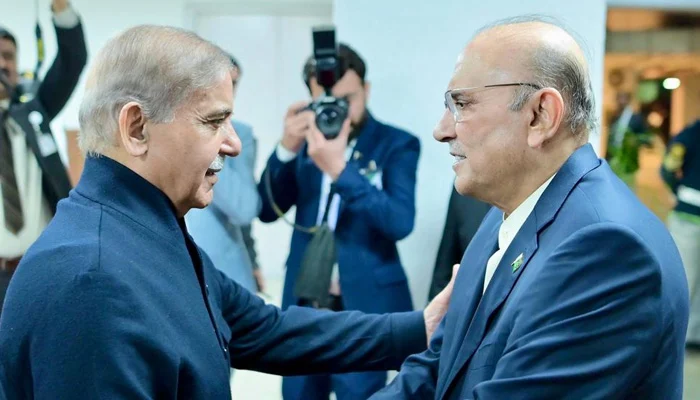
President Asif Ali Zardari and Prime Minister Shehbaz Sharif held discussions on Sunday regarding the evolving political situation and government formation in Azad Jammu and Kashmir (AJK). The conversation came as both parties — the Pakistan Peoples Party (PPP) and Pakistan Muslim League-Nawaz (PML-N) — weighed their next steps amid growing uncertainty in the region’s assembly.
Sources revealed that President Zardari took Prime Minister Shehbaz Sharif into confidence over the PPP’s intent to form the government in AJK. Following their discussion, Shehbaz directed the PML-N’s AJK Affairs Committee to begin talks with the PPP leadership. The committee, comprising Ahsan Iqbal, Rana Sanaullah, and Amir Muqam, has started consultations with the AJK chapter of the party to finalize its stance before engaging in formal negotiations.
Read more : Shehbaz Sharif to Boost Pakistan-Saudi Economic Cooperation at Riyadh Summit
However, the PML-N’s parliamentary leader and former AJK Prime Minister Raja Farooq Haider announced that his party would not participate in any coalition and had decided to sit in the opposition. He stressed that the decision was final and would not be revised. Meanwhile, PPP leader Qamar Zaman Kaira stated that the PML-N had not officially communicated its decision, and the PPP would proceed to form a government if it secured the required majority.
At the same time, AJK Prime Minister Chaudhry Anwar-ul-Haq has begun consultations to decide whether to resign voluntarily or face a potential no-confidence motion. Insiders suggest that a major decision is expected within the next 48 hours, which could reshape the political balance in the region’s assembly.
Read more : Pakistan, Egypt Vow to Boost Security and Economic Ties
In the 52-member AJK Legislative Assembly, a party needs 27 seats to secure a majority. The PPP currently holds 17 seats, while the PML-N has 9, the PTI 4, and two smaller parties — the Muslim Conference and Jammu Kashmir People’s Party — hold one seat each. A forward bloc of 20 members now holds the key to government formation. If the PML-N had supported the PPP, their combined tally would have reached 26 — one short of a majority — but with PML-N choosing opposition benches, the PPP must now seek alliances within the forward bloc to form the government.