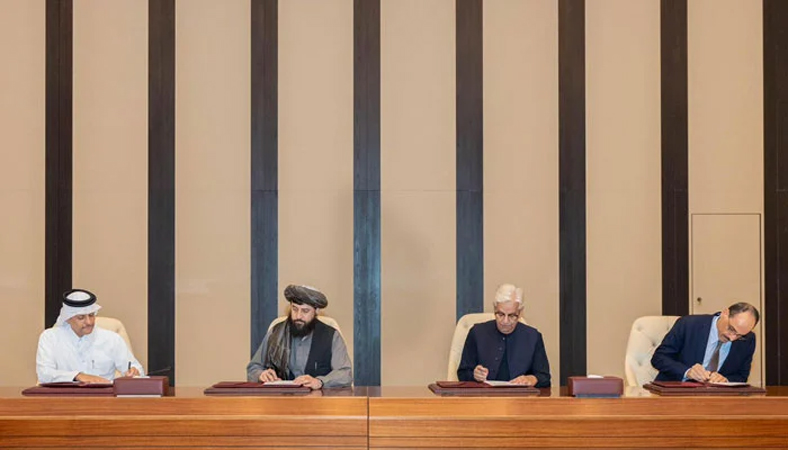
 The second round of talks between Pakistan and Afghanistan kicked off in Istanbul on Saturday, with Islamabad eyeing a “concrete” mechanism to monitor Afghan Taliban actions aimed at preventing cross-border terrorist attacks.
The meeting follows the first round of Pakistan-Afghanistan talks mediated jointly by Qatar and Turkiye in Doha on October 18-19.
The Qatar talks had come after days of fighting along the Pak-Afghan border – where trade is still closed – and strikes by Islamabad on Gul Bahadur group camps in Afghanistan. The agreement reached in Doha extended an initial 48-hour truce and resulted in a permanent ceasefire, as well as a commitment to reconvene in Istanbul to work on mechanisms for lasting peace and stability between the two countries.
According to Afghan interim administration spokesman Zabihullah Mujahid, the Afghan delegation was to be led by Mawlawi Rahmatullah Najeeb, deputy minister at Ministry of Interior, Turkish news agency Anadolu reported.
Islamabad has not said who it has sent to the talks. It was also not clear where exactly the negotiators were meeting in Turkey’s largest city, nor how long the talks would continue.
“The remaining issues [with Pakistan] will be discussed in the meeting,” Mujahid said in a post on X last night, adding that the Afghan delegation had left Kabul for Istanbul.
“Pakistan looks forward to the establishment of a concrete and verifiable monitoring mechanism in the next meeting to be hosted by Turkiye in Istanbul on Oct 25, 2025, to address the menace of terrorism emanating from Afghan soil towards Pakistan and prevent any further loss of life of Pakistanis,” the new Foreign Office (FO) spokesperson, Tahir Hussain Andrabi, said at his maiden weekly media briefing on Friday.
In essence, Doha produced the political breakthrough, while Istanbul is expected to operationalise it by defining what constitutes cross-border terrorism, how violations will be verified and how disputes will be resolved.
Turkish officials have indicated that a technical committee in Istanbul will review details of the ceasefire, including terrorism, migration and border security.
At the talks, Pakistan is expected to seek concrete and verifiable commitments from the Afghan side to eliminate the threat of the banned Tehreek-i-Taliban Pakistan (TTP) from its territory, which Pakistan says uses Afghan soil to launch attacks across the border.
The agenda includes dismantling known TTP sanctuaries, arresting or expelling key figures and defining clear timelines and benchmarks for measurable action such as raids, arrests and destruction of safe houses.
Pakistan also supports establishing a third-party oversight structure, potentially co-chaired by Turkiye and Qatar, to verify progress and address non-compliance.
Additional priorities will include securing Afghan assurances against providing safe havens to hostile groups, strengthening border control, ensuring financial transparency on militant funding and holding regular review meetings to assess compliance.
The truce agreed in Doha has largely held, with no major terrorist attacks reported since, according to the FO.
Meanwhile, Defence Minister Khawaja Asif said he believes Afghanistan wants peace but that failure to reach an agreement during talks in Istanbul would mean “open war”.
Asif said there had been no incidents in the four to five days since the ceasefire was agreed, and both sides were complying with the truce.
“We have the option, if no agreement takes place, we have an open war with them,” he said, adding: “But I saw that they want peace.”