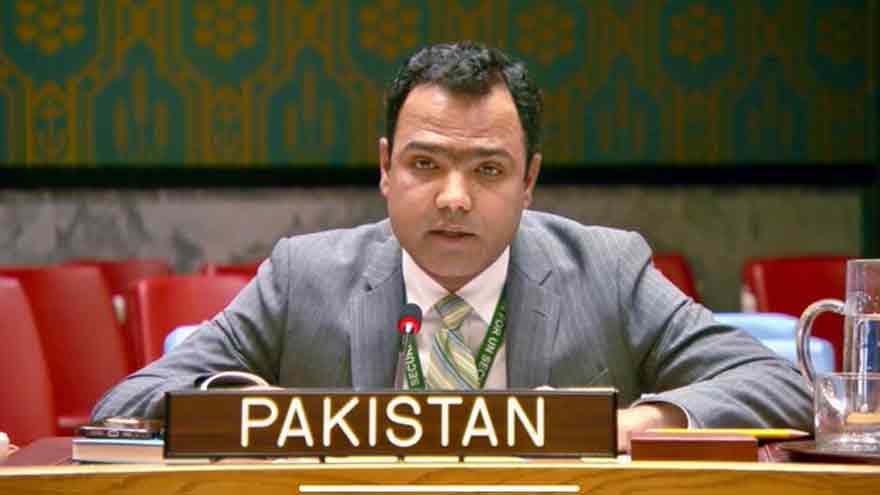
NEW YORK – Pakistan has strongly condemned India’s treatment of religious minorities, accusing New Delhi of enabling widespread persecution of Muslims, Christians, and Sikhs under its Hindutva-driven policies.
The remarks were delivered by Gul Qaiser Sarwani, Counsellor and Political Coordinator of Pakistan’s Permanent Mission to the United Nations (UN), in response to statements made by the Indian representative.
Sarwani cited a series of violent incidents — including the 2002 Gujarat riots, the 1984 anti-Sikh violence, and recent religious clashes in Delhi and Manipur — as evidence of what he described as India’s “systemic campaign of hate.” He condemned public lynchings of Muslims, attacks on churches, and the demonization of Sikhs, calling these acts symptoms of an entrenched ideology of intolerance. “India has turned into the world’s largest factory of hate,” Sarwani said, urging the UN Security Council (UNSC) and the broader international community to take concrete action to hold India accountable for ongoing human rights violations.
Read More: Pakistan’s Water Crisis
In his address, Sarwani also reaffirmed Pakistan’s position on the Jammu and Kashmir dispute, stressing that the territory remains an internationally recognized disputed region. He called on India to implement UN Security Council resolutions, end “state terrorism,” and respect the fundamental rights of the Kashmiri people.
Pakistan’s envoy further contrasted the situation in Azad Jammu and Kashmir, which he described as a region upholding democratic values, with the “repressive conditions” in Indian-administered Kashmir. “On the 80th UN Day, India must return to compliance with the UN Charter and fulfill its obligations under international law,” Sarwani concluded.