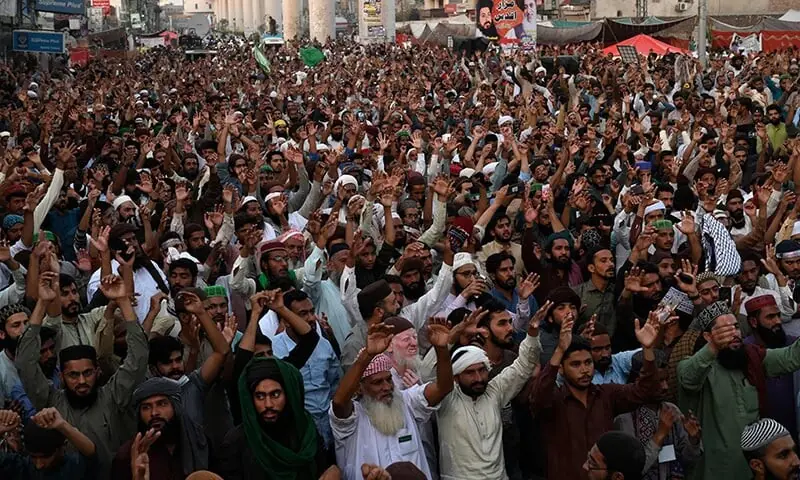
ISLAMABAD – The government’s ban on Tehreek-i-Labbaik Pakistan (TLP) has left the once-powerful religio-political group isolated, as no major religious or political party has stepped forward to defend it this time. The Interior Ministry on Friday formally notified the ban on TLP, a day after the Punjab government’s proposal was approved by the federal cabinet.
According to the notification — SRO 2011(1) of 2025 — TLP has been declared a proscribed organisation under Section 11B(1)(a) of the Anti-Terrorism Act (ATA) 1997 and placed on the Act’s First Schedule. The group can appeal to a review committee comprising officials from the Ministry of Law and Justice and the Ministry of Interior within 30 days.
Read More: Government officially bans TLP under anti-terrorism law
Following the move, the National Counter Terrorism Authority (NACTA) issued advisories to all provinces, law enforcement agencies, the banking sector, the Election Commission, and other institutions to impose restrictions applicable to proscribed entities. These include sealing party offices, banning promotional material, press statements, and conferences, imposing financial sanctions, and restricting political and social activities.
Adviser to the Prime Minister on Political Affairs Rana Sanaullah claimed on Friday that the TLP was originally “created to cut into PML-N’s vote bank.” Speaking to Geo News, he said the group had been used in the past for political engineering but clarified that its current ban was based on security considerations, not politics. “It is very difficult for a party to function while they are banned under the ATA,” he said, adding that TLP cannot contest elections while the ban remains in place.
Read More: Interior Ministry notifies ban on TLP
TLP now becomes the third religio-political party — and the first from the Barelvi school of thought — to be declared proscribed, and the first political party to be banned twice. It was briefly banned in 2021 by the PTI-led government before the prohibition was lifted following assurances of non-violence.
Unlike previous bans on groups like Sipah-i-Sahaba Pakistan (SSP) and Tehreek-i-Jafria Pakistan (TJP), no major religious or political organisation has spoken in TLP’s defense this time. Observers say that many expect TLP’s members to rejoin their original parties, primarily from Barelvi networks, before the group’s formation in 2015.
Read More: Govt outlaws TLP
Following the notification, the Punjab government sealed several mosques associated with TLP supporters. However, after negotiations, all mosques were reopened for prayers, according to Mufti Gulzar Naeemi of Tanzeemat Ahl-i-Sunnat Pakistan. Council of Islamic Ideology (CII) member Hafiz Tahir Mehmood Ashrafi opposed any move obstructing worship, clarifying that no mosques would be handed over to Deobandi administrators, contrary to social media speculation.
TLP was founded in 2015 by the late Allama Khadim Hussain Rizvi, emerging from the Sunni Ittehad Council (SIC), which had focused on defending the finality of Prophethood. SIC chief Sahibzada Hamid Raza reiterated that violence-based politics harms the Barelvi community and the nation, distancing his group from TLP’s confrontational approach.
Read More: ATC sends 8 TLP workers to jail for identification parade
Prominent cleric Mufti Muneebur Rehman, who had earlier mediated during the 2021 talks, has remained silent on the latest developments. Sources said Interior Minister Mohsin Naqvi recently met him to remind TLP’s guarantors of their 2021 commitment not to challenge the state’s writ. Mr Ashrafi said TLP had “violated its own commitments” and alienated scholars through “harassment and ridicule.” He added, “They mocked everyone who tried to calm them — that’s why nobody wants to speak on their behalf now.”