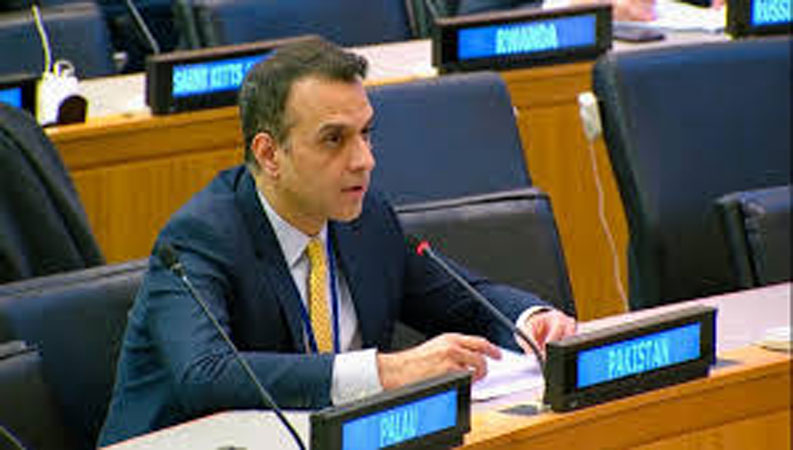
 Reaffirming its commitment to the goal of a nuclear-weapon-free world, Pakistan told a UN panel Tuesday that the global disarmament and arms control framework was under stress.
“We are witnessing a troubling regression,” Ambassador Usman Jadoon, acting permanent representative of Pakistan to the UN, said in the course of a thematic debate on nuclear weapons in the General Assembly’s First Committee, which deals with disarmament and international security matters.
“The salience of nuclear weapons in military doctrines is rising along with modernization of arsenals, heightening new risks of escalation,” he warned, while citing India’s actions that include expansion of unsafeguarded stockpiles.
“Compounding this is the weaponization of emerging technologies – blurring the line between conventional and nuclear domains and increasing risks of miscalculation,” the Pakistani evoy said.
“We also see States with vast fissile material stockpiles pushing selective, cost-free proposals, such as focusing only on a cut-off, while ignoring existing asymmetries,” Ambassdaor Jadoon said
At the same time, he added, the non-proliferation regime is weakened by discriminatory waivers and selective safeguards, especially in the transfer of nuclear material and sensitive technology.
India has benefited from special nuclear cooperation agreements primarily by ending its decades-long nuclear isolation and gaining access to international nuclear technology, fuel, and trade. These agreements began with a landmark 2008 waiver from the Nuclear Suppliers Group (NSG) and have continued to evolve, most recently with new commitments to partnership in early 2025.
In his comment, Ambassador Jadoon, without naming India, said, “Our eastern neighbour continues to expand unsafeguarded stockpiles while benefiting from special nuclear cooperation agreements.
It has raised the operational readiness of its arsenal through canisterization of delivery systems – despite a record of accidental launches.”
In addition, the Pakistani envoy said India used dual-capable delivery systems for the first time – “a reckless act that heightened regional instability and underscored the fragility of nuclear restraint”.
Emphasizing that disarmament must address both regional and global realities, he said that the reasons for some states retaining nuclear weapons were clear: unequal security environments, unresolved disputes, threats from larger military states, failure of the UN to implement its own Charter and resolutions, and discrimination in applying international norms.
“Until we achieve a world without nuclear weapons, the negotiation of a legally binding instrument providing non-nuclear-weapon States with assurances against the use or threat of use of such weapons is the most urgent priority.
Kosovo
Pakistan has called for sustained Kosovo-Serbia dialogue and full implementation of their 2013 and 2023 agreements to ensure lasting peace, stability and tranquillity in the Southeast European region.
“We hope that both sides will sincerely commit to the political process and refrain from unilateral actions that escalate tensions,” Ambassador Usman Jadoon, acting permanent representative of Pakistan to the United Nations, told the UN Security Council on Tuesday.
Speaking in the course of a debate on the United Nations Mission in Kosovo (UNMIK), he expressed concern over the divisive rhetoric, hate speech, and incidents of religious intolerance.
“All efforts must be made, by both sides, to effectively curb such negative trends that give rise to communal tensions (between Serbs and Albanians), the Pakistani envoy said, noting UNMIK’s efforts to foster dialogue, promote harmony and spirit of co-existence among various communities in Kosovo.
Kosovo declared independence from Serbia in February 2008 following years of ethnic tensions, but Serbia has not recognized the declaration. The EU has since been facilitating dialogue between the parties on a range of practical matters.
In his remarks, Ambassador Jadoon said, “We are concerned by the lack of tangible progress to bring those responsible for the Iber-Lepenc canal and the Banjske attack of 2023 to justice,” hoping that authorities from both sides would cooperate earnestly towards that end.
Pakistan, he pointed out, has friendly relations with both Kosovo and Serbia, and a steadfast supporter of a stable and prosperous Balkans.
“This, we believe can only be achieved through commitment to the principle of peaceful co-existence, showing mutual respect, recognizing mutual sensitivities and by earnestly abiding to the previous agreements,” the Pakistani envoy added.