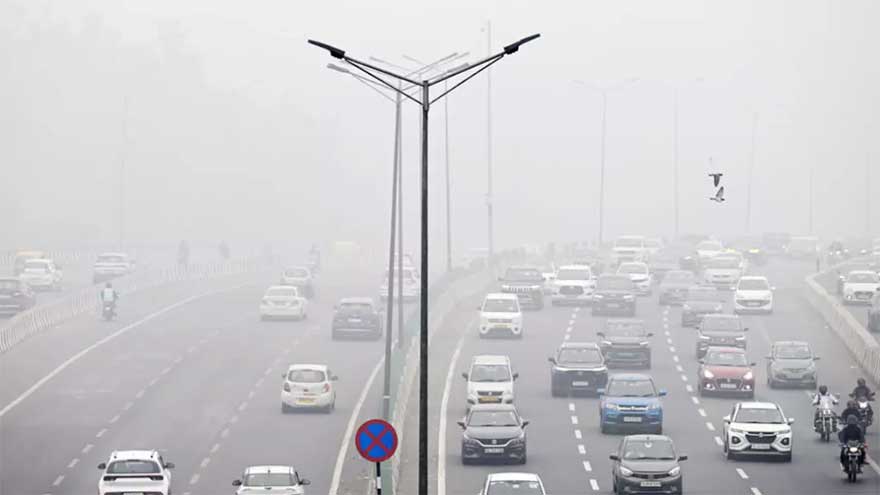
NEW DELHI: India’s capital New Delhi was engulfed in a thick, toxic haze on Monday as air pollution levels soared to more than 16 times the World Health Organisation’s (WHO) recommended safe limit, posing serious health risks to its residents.
Home to over 30 million people, New Delhi and its surrounding metropolitan region are routinely ranked among the most polluted capitals in the world, with smog choking the skyline each winter.
Experts say the problem intensifies as cooler air traps pollutants close to the ground, creating a deadly mix of emissions from vehicles, factories, and crop burning. This year, the situation worsened due to days of fireworks during Diwali, the Hindu festival of lights that culminated on Monday night.
Read More: Delhi Will Be Khalistan, Says Pannun
Despite a partial Supreme Court relaxation on the blanket firecracker ban—allowing the use of so-called “green firecrackers” designed to emit fewer particulates—compliance has been limited, as similar bans were ignored in previous years.
According to IQAir, a global air quality monitoring organization, levels of PM2.5—microscopic particles small enough to enter the bloodstream—hit 248 micrograms per cubic metre in several areas of the city, far exceeding the WHO’s recommended limit of 15 micrograms.
The Commission of Air Quality Management (CAQM) has warned that conditions may deteriorate further in the coming days. It has directed authorities to ensure uninterrupted electricity supply to discourage the use of diesel generators and to step up monitoring of emissions from industrial zones.
Read More: Symbolic Khalistan Embassy Opens in Canada
In an unprecedented move, city officials plan to trial cloud seeding to trigger artificial rainfall and help clear the air. “We’ve already got everything we need to do the cloud seeding,” Delhi Environment Minister Manjinder Singh Sirsa said, confirming that flight trials and pilot training had been completed earlier this month.
A Lancet Planetary Health study last year estimated that 3.8 million deaths in India between 2009 and 2019 were linked to air pollution. Meanwhile, UNICEF has warned that polluted air puts children at a heightened risk of developing acute respiratory infections.
As New Delhi continues to struggle with its annual smog crisis, experts urge stronger enforcement of environmental regulations and a shift toward cleaner energy and transport systems to avert future health disasters.