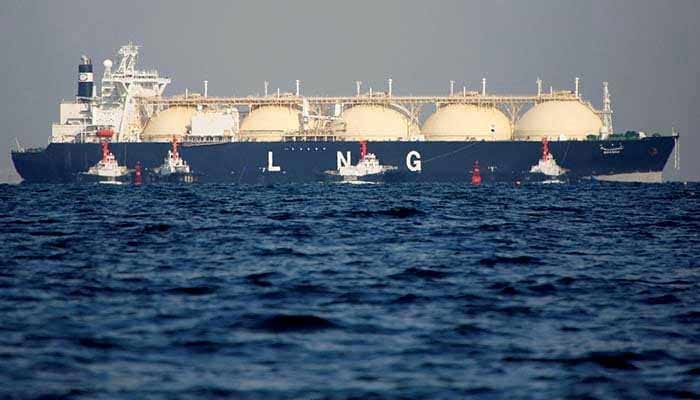
ISLAMABAD – Pakistan has asked Qatar to divert 24 of its contracted LNG cargoes to the international market in 2026 due to declining domestic demand and an oversupply of imported gas, The News reported on Saturday.
Officials from the Petroleum Division said the proposal would be finalised by the end of October under the Net Proceed Differential (NPD) clause of Pakistan’s long-term LNG deals with Qatar. Under this clause, any resale profits from diverted cargoes go to Qatar, while Pakistan must bear losses if global spot prices fall below contract levels.
Read More: Japan’s JERA Explores LNG Deal With Alaska Project
By contrast, Pakistan’s deal with Italy’s ENI allows for profit-and-loss sharing, and one ENI cargo per month is already being diverted to the international market through 2025–26. Pakistan currently imports nine LNG cargoes per month from Qatar — five under a 15-year contract priced at 13.37% of Brent and four under a 10-year contract priced at 10.2% of Brent. Both are rigid “Take-or-Pay” agreements, meaning Pakistan must pay even if it does not use the gas.
The LNG was mainly intended for four RLNG-based power plants in Punjab — Haveli Bahadur Shah, Balloki, Bhikki, and Trimmu — now operating far below capacity. Due to reduced consumption, Pakistan faces an annual surplus of 35 cargoes, including 11 from ENI. Line-pack pressure in the RLNG system has exceeded the 5 bcf safety limit, reaching 5.17 bcf, posing risks of system failure.
To manage the situation, domestic gas fields producing 270–400 mmcfd have been temporarily shut down — a move that could permanently damage some wells and reduce crude oil and LPG output. Attock Refinery Limited has already warned that lower crude supply is limiting its operations.
Read More: Iraq’s Gas Deal Collapses Under U.S. Sanctions Pressure
Demand from both the power and export sectors has sharply declined. As of October 17, the power sector was consuming only 486 mmcfd against a commitment of 800 mmcfd, while export industries’ RLNG use dropped from 350 mmcfd to just 100 mmcfd. Officials attribute the decline to high RLNG prices — about Rs3,500 per MMBtu, plus a 5% off-grid levy of Rs570 per MMBtu.
Although the RLNG power plants were originally designed as “must-run” units with a 66% take-or-pay clause, the ECC cut it to 50% in 2020. The plants now run on the Economic Merit Order, which prioritizes cheaper power sources, making LNG less viable.
This shift has created major financial challenges for Pakistan State Oil (PSO) and the government. In FY2024–25 alone, RLNG worth Rs242 billion had to be redirected to domestic consumers to manage the oversupply.