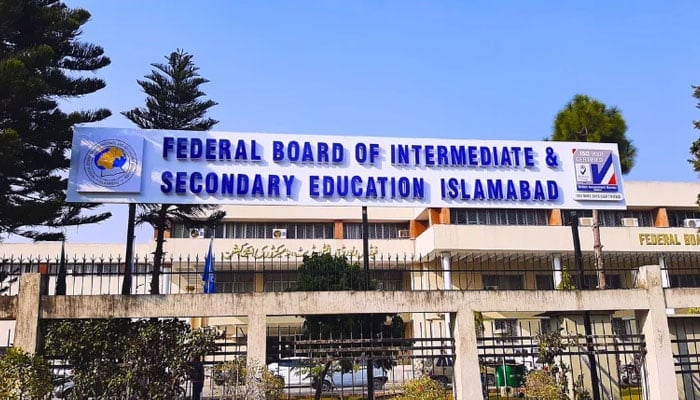
The Federal Board of Intermediate and Secondary Education (FBISE) has officially replaced its old syllabus with the newly developed Curriculum 2024, marking a major step toward modernizing Pakistan’s education system. The updated framework is designed to improve learning standards and align with global academic requirements. According to the board, the new syllabus takes effect immediately across all affiliated institutions nationwide.
The Board has uploaded the new curriculum on its official website to ensure students and teachers can easily access study materials. Officials emphasized that the revised syllabus focuses on enhancing students’ conceptual understanding, analytical thinking, and problem-solving skills. It aims to bridge the gap between classroom learning and practical application, preparing students for higher education and professional challenges.
Read more : Historic Trade Milestone: Pakistan and U.S. Finalize Major Tariff Agreement
Moreover, the notification issued by the Board instructs all educational institutions affiliated with FBISE to adopt the new curriculum without delay. Schools and colleges have been urged to begin teaching according to the new syllabus to ensure consistency in learning standards across the country. Inspections will also be carried out to confirm that the changes are being implemented effectively and uniformly.
Officials said the Curriculum 2024 introduces innovative teaching methodologies and updated subject content to make education more relevant and engaging. The new design also focuses on technology integration, encouraging students to develop digital literacy and creative skills essential in today’s world. Teachers will receive additional support and training to ensure smooth adaptation to the new academic framework.
Education experts believe this initiative will help students stay competitive in an evolving academic environment. By combining modern knowledge with practical learning, the new curriculum aims to nurture critical thinkers and innovators. The Federal Board stated that this transformation marks the beginning of a new era in education focused on quality, inclusivity, and forward-looking development.