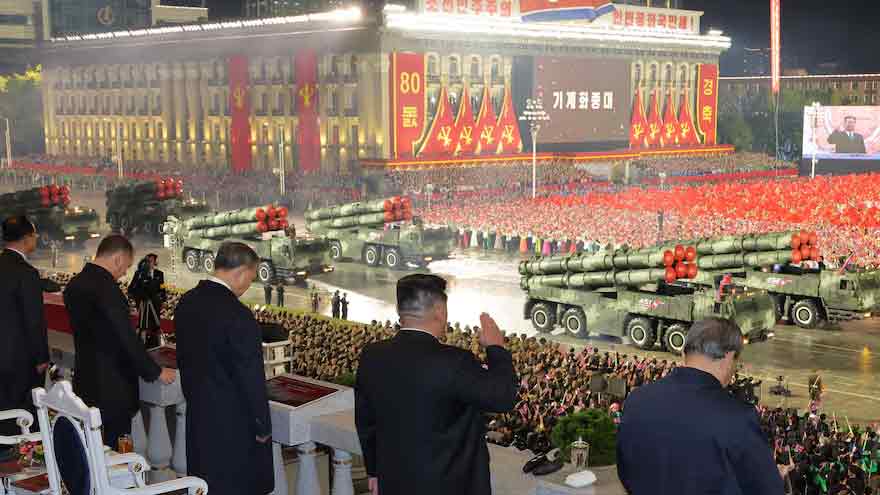
SEOUL – North Korean leader Kim Jong Un oversaw a grand military parade in Pyongyang late Friday, showcasing the country’s newest Hwasong-20 intercontinental ballistic missile (ICBM) — described by state media as its “strongest nuclear strategic weapon system.”
The parade, held to commemorate the 80th anniversary of the ruling Workers’ Party, was attended by Chinese Premier Li Qiang, Russia’s former President Dmitry Medvedev, and Vietnamese Communist Party chief To Lam, marking one of the most significant international gatherings in Pyongyang in recent years. According to the Korean Central News Agency (KCNA), the Hwasong-20 ICBM represents the “pinnacle” of North Korea’s nuclear deterrence capability, capable of striking anywhere within the U.S. mainland.
Read More: Kim Boasts of North Korea’s Standing at Celebration
While experts question the missile’s guidance precision and warhead re-entry capability, analysts say the weapon marks a major leap in North Korea’s nuclear ambitions. “The Hwasong-20 represents, for the moment, the apotheosis of North Korea’s ambitions for long-range nuclear delivery capabilities,” said Ankit Panda, a senior fellow at the Carnegie Endowment for International Peace. “We should expect to see the system tested before the end of this year.”
Panda added that the missile could potentially carry multiple warheads, making it more difficult for U.S. missile defense systems to intercept and furthering Pyongyang’s goal of credible deterrence against Washington. During the parade, Kim Jong Un praised the heroism of North Korean troops, not only in defending the homeland but also in what he called “outposts of socialist construction.” “Our army should continue to grow into an invincible entity that destroys all threats,” Kim declared in his address, according to KCNA.
Read More: S. Korea Summons Cambodian Envoy Over Job Scam Crisis
Following the parade, Kim held bilateral talks with Dmitry Medvedev, head of the Russian delegation.
Medvedev reportedly praised North Korean soldiers fighting alongside Russian forces in Ukraine, describing their “sacrifice” as proof of the deep trust and friendship between Moscow and Pyongyang.
Kim, in turn, expressed his desire to strengthen cooperation with Russia and expand strategic exchanges to pursue “common goals” in defense and technology. The high-profile event underscores North Korea’s deepening alignment with Russia and China, as tensions with the West continue to escalate over its weapons program and alleged arms supplies to Moscow.