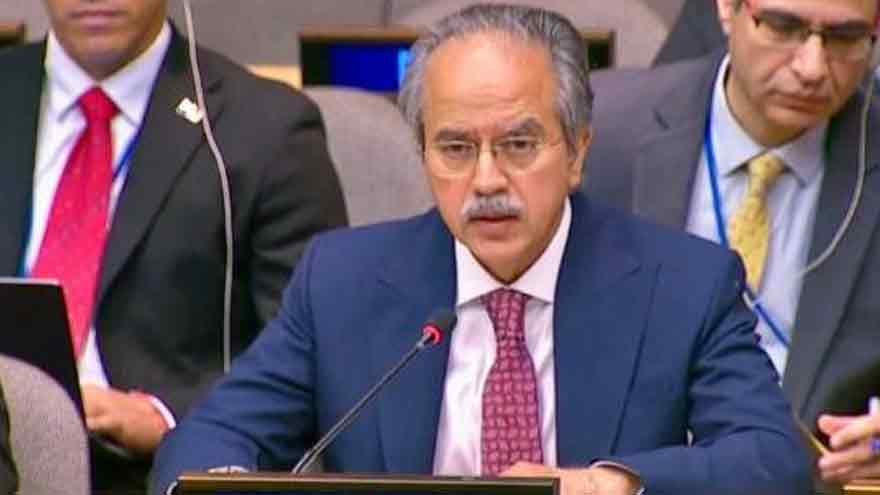
NEW YORK – Pakistan has urged the international community to uphold the rule of law in resolving long-standing disputes such as Palestine and Kashmir, saying that peace cannot be achieved without justice and accountability.
Speaking at the UN General Assembly’s Legal Committee, Ambassador Asim Iftikhar Ahmad, Pakistan’s permanent representative to the UN, condemned ongoing violations of international law by certain states. “Peace and security are under threat from military provocations, aggressive designs and illegal actions, including the suspension of international treaties once considered sacrosanct,” Ambassador Ahmad said.
Read More: Hamas Rejects Foreign Control Over Gaza’s Future Governance
He warned of a growing trend of territorial aggrandizement and unilateralism, emphasizing that the international community must ensure respect for established norms and laws. Referring to Palestine and Indian-occupied Kashmir, the envoy said that ending decades-long occupations requires true adherence to international law. “Without accountability, peace remains elusive,” he stressed.
The ambassador also recalled India’s aggression against Pakistan earlier this year, describing it as a “grave breach of international law” and a violation of sovereignty. Pakistan’s response, he said, was “decisive, proportionate, and in line with Article 51 of the UN Charter.” Turning to the Middle East, Ambassador Ahmad said that Palestine has suffered for too long due to Israel’s “inhuman, indiscriminate and illegal use of force” against civilians in Gaza and other areas.
Read More: European Powers Push UN to Support Gaza Peace
He reaffirmed Pakistan’s commitment to peaceful dispute resolution, referencing UN Security Council Resolution 2788, adopted under Pakistan’s presidency, which promotes the pacific settlement of disputes. “Security Council resolutions form part of international law and impose binding obligations on member states,” he noted, urging consistent implementation to maintain their integrity.
Marking the 80th anniversary of the United Nations, the ambassador called for the democratization of international law to make global norms more inclusive and equitable. In closing, Ambassador Ahmad said, “Strengthening the international rule of law will be a lasting legacy for future generations. It will help the world move from anarchy and conflict to cooperation and stability.”