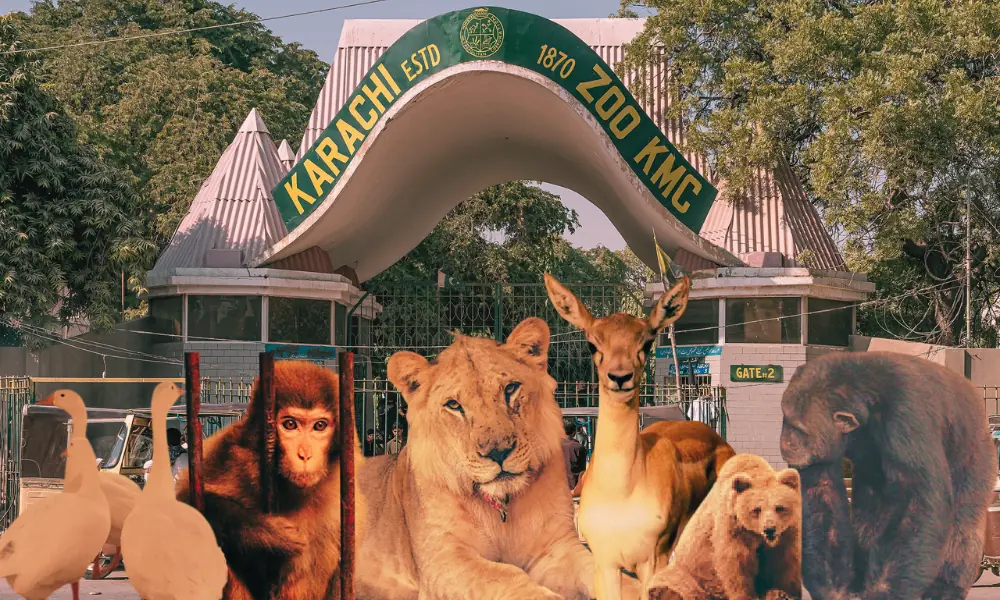
KARACHI: The tragedy of Karachi Zoo is not confined to dying animals — it’s a chilling reflection of human apathy and moral decay.
In a deeply moving investigative feature, journalist Aniqa Atiq Khan lays bare the horrors inside Karachi Zoo, where lions lie motionless, monkeys lick rusted bars, and a Himalayan brown bear named Rano paces endlessly in psychotic despair. “Captivity is its slow suffocation,” Khan writes, recalling the lifeless eyes of the animals trapped in rusting cages, while families picnic, children zip-line, and Bollywood music blares through speakers.
Read More: Ambani Zoo Faces Supreme Court Inquiry Over Wildlife Allegations
The contrast is grotesque — a festival of human laughter set against a graveyard of forgotten creatures. Cafés named after lions thrive just meters away from their suffering namesakes.
Animal welfare experts describe the zoo as a “prison”, not a sanctuary. Zohare Ali Shariff, a veteran in wildlife management, argues that most enclosures are psychologically torturous: “You can’t tease them. This is just the opposite. These are prisons.”
Rano’s story epitomizes the zoo’s cruelty. Once trapped in a “bear pit,” she now lives in a marginally larger cage — pacing endlessly under Karachi’s blistering sun, her wound infested with maggots after she repeatedly rammed her head into the bars.
Read More: Thailand’s Pet Lion Boom Raises Alarm
Activists like Jude Allen and Mahera Omar of PAWS highlight the absence of “enrichment” — essential space, natural textures, and stimuli that mimic the wild. Instead, the zoo has become a profit machine where ghost employees thrive and revenues from ticket sales vanish without trace. “There’s enough money to make the zoo a sanctuary,” Allen says. “It’s infuriating to see neglect while the administration calls it progress.”
The Karachi Metropolitan Corporation (KMC), which runs the zoo, dismisses these allegations, insisting that “as long as an animal can walk, eat, and looks fine, it is healthy.”
Read More: Shark attack kills surfer off Sydney beach
Yet experts counter that physical survival isn’t the same as well-being — and that Karachi Zoo’s animals are enduring a slow psychological death.
Beyond the zoo, the report exposes a deeper cultural rot — a society where exotic animals are kept as luxury pets or wedding props, where empathy is traded for spectacle, and where cruelty is disguised as education.
Khan draws on global parallels, invoking the legacy of Jane Goodall, who spent her life dismantling humanity’s illusion of superiority. “Until we learn to see the beating hearts beneath fur, feather, and scale as kin rather than conquest,” she writes, “we remain the lesser species — clever, yes, but not yet wise.”