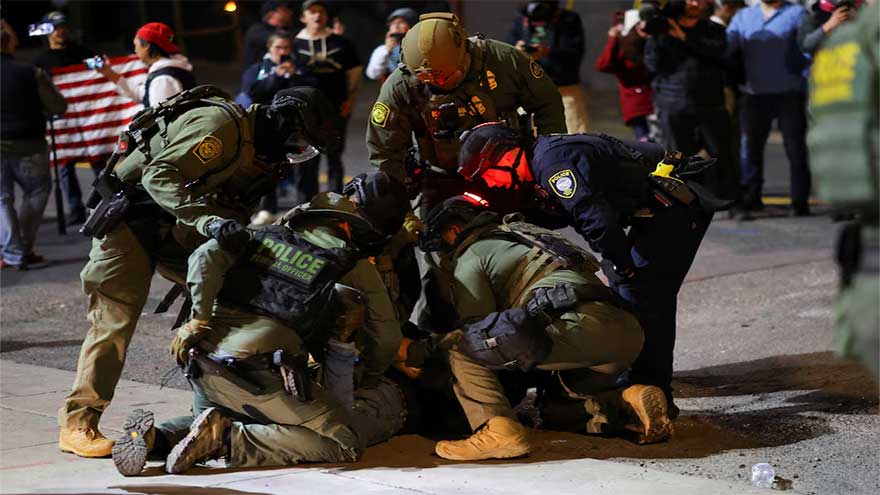
PORTLAND, Oregon — A U.S. federal judge on Sunday temporarily blocked the Trump administration from deploying National Guard troops to Portland, dealing a significant blow to the president’s efforts to use federal forces in cities governed by Democrats.
The ruling by U.S. District Judge Karin Immergut came just a day after she had restricted the deployment of Oregon’s own National Guard to the city. The Trump administration had attempted to circumvent that decision by calling in federalized units from California and Texas — a move the judge said directly violated her earlier order. “How could bringing in federalized National Guard from California not be in direct contravention of the decision I issued yesterday?” Judge Immergut asked Justice Department attorney Eric Hamilton during the hearing. “Is there any legal authority for what you are doing?”
Hamilton argued that the California National Guard had been federalized under a June 7 mission to protect federal property nationwide, claiming the deployment to Portland was consistent with that order.
But Oregon’s attorney, Scott Kennedy, denounced the move as “gamesmanship” and an attempt to evade judicial oversight, saying it defied both the spirit and letter of the court’s ruling. “It feels like we’re playing a game of rhetorical whack-a-mole here,” Kennedy said.
Judge Immergut’s order, effective until October 19, blocks the administration from sending National Guard troops from any state or Washington, D.C., to Portland while Oregon and California pursue a longer-term injunction. The White House and Pentagon did not immediately respond to requests for comment.
Earlier on Sunday, Trump lashed out at Immergut, mistakenly referring to her as “him,” and saying he had not been “served well” by those who advised him to appoint her during his first term. “That judge ought to be ashamed of himself,” Trump said, unaware that Immergut is a woman.
Read More: Neglect at Karachi Zoo Leaves Bear Fighting for Life
Pentagon’s Role and State Reactions
The Pentagon confirmed it had called in 200 California National Guard troops to Oregon to assist federal law enforcement and protect property, along with another 400 troops from Texas to be deployed to Chicago, Portland, and other cities. Democratic leaders reacted sharply. California Governor Gavin Newsom condemned the federal action as “a breathtaking abuse of the law and power,” accusing the Trump administration of attacking state sovereignty. Oregon’s government argued that the move violated multiple federal laws and infringed on the state’s constitutional right to control its own police powers.
Legal and Political Implications
Judge Immergut, herself a Trump appointee, emphasized that while presidents are owed “a great level of deference” in military decisions, that authority is not absolute.
Accepting the administration’s argument, she wrote, would mean the president could “send military troops virtually anywhere at any time” — blurring the line between civil authority and military power, a risk she said “cuts to the core of American democracy.” The Trump administration immediately appealed her Saturday ruling, arguing that Immergut had “impermissibly second-guessed the Commander in Chief’s military judgments.”
Yet Immergut reiterated Sunday that “nothing has changed” since her initial decision, insisting the protests in Portland did not justify a federal military presence. “The facts on the ground remain the same,” she said. “There is no emergency warranting military deployment in Portland.”
Context: Expanding Military Use at Home
The dispute marks the latest in a series of escalating confrontations over Trump’s domestic use of the military. In recent months, his administration has sent National Guard troops to Los Angeles, Washington, D.C., and the southern border, often over the objections of local authorities.
The Oregon standoff underscores a broader debate over federal overreach and state autonomy, with critics warning that the president’s approach risks militarizing domestic law enforcement and undermining civil liberties.
As Oregon’s case proceeds, it could set a precedent limiting how future administrations deploy the National Guard on U.S. soil — especially in states unwilling to surrender their constitutional authority to federal command.