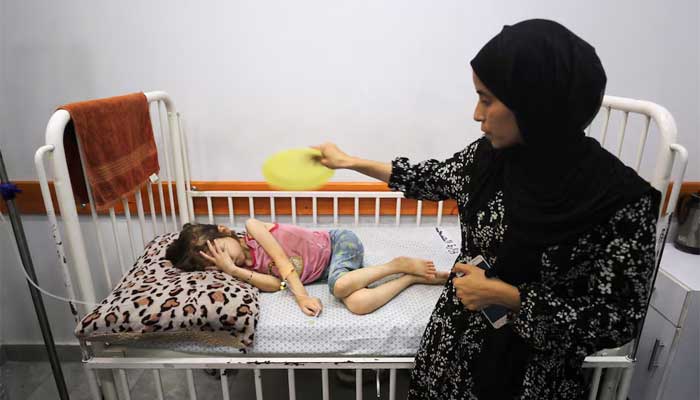
Two years of war, multiple displacements, and the deaths of her husband and father have turned 31-year-old Lamis Dib’s life in Gaza into a relentless fight for survival.
“Friday, October 6, 2023, the last day before the war, was a beautiful day,” Dib recalled. Her daughter Suwar, then five, had just begun kindergarten, and she would watch her return from school every afternoon in their Sheikh Radwan apartment in Gaza City. Her younger son Amin, just three, filled her days with trips to the seaside. With her husband, an accountant who provided a secure life, she felt she had built “a happy family.”
Read More: Karachi Protest Demands Release of Pakistanis Detained on Gaza Flotilla
But their neighborhood was among the first hit when Israel launched its military campaign in October 2023. Since then, more than 66,000 Palestinians — mostly civilians — have been killed, according to Gaza’s health ministry, with the UN calling the figures reliable. Entire neighborhoods have been flattened, leaving millions of tonnes of rubble where homes, hospitals, schools, and water systems once stood.
For Dib and her family, survival meant constant displacement. They fled north Gaza for Khan Yunis and later to Rafah, where overcrowding and shortages were crushing. “Thirty of us would sleep in a single room with no toilets,” she said, describing months of confinement, hunger, thirst, and a total lack of privacy.
By the time they had been displaced 11 times, tragedy struck again. In August 2024, while living in Nuseirat refugee camp, her husband and father were killed in an Israeli missile strike. “I ran towards the rooftop, and the scene was unimaginable; they were all dead,” she recalled. “My husband’s body seemed intact — I thought he was alive. But he had been struck in the head. And then I found my father’s body, his hand blown off.”
Widowed and grieving, Dib now lives with her children in a flimsy tent in Al-Zawayda camp, where thousands endure heat, wind, and flooding. She shoulders the financial and emotional burden alone. “Everything is difficult,” she said. “Our children were robbed of education, food, and a normal life.”
Israel briefly eased its blockade in May 2025, but the UN says aid trickling in is far from enough. Her children, Suwar and Amin, help fetch water in jerrycans, their days consumed by survival. Sometimes, they look through photos of their father on her phone, reminders of a life lost to war.
Still, Dib clings to hope. “We’ll return to our home. We will rebuild it,” she said softly. “But we just want a little bit of peace.”