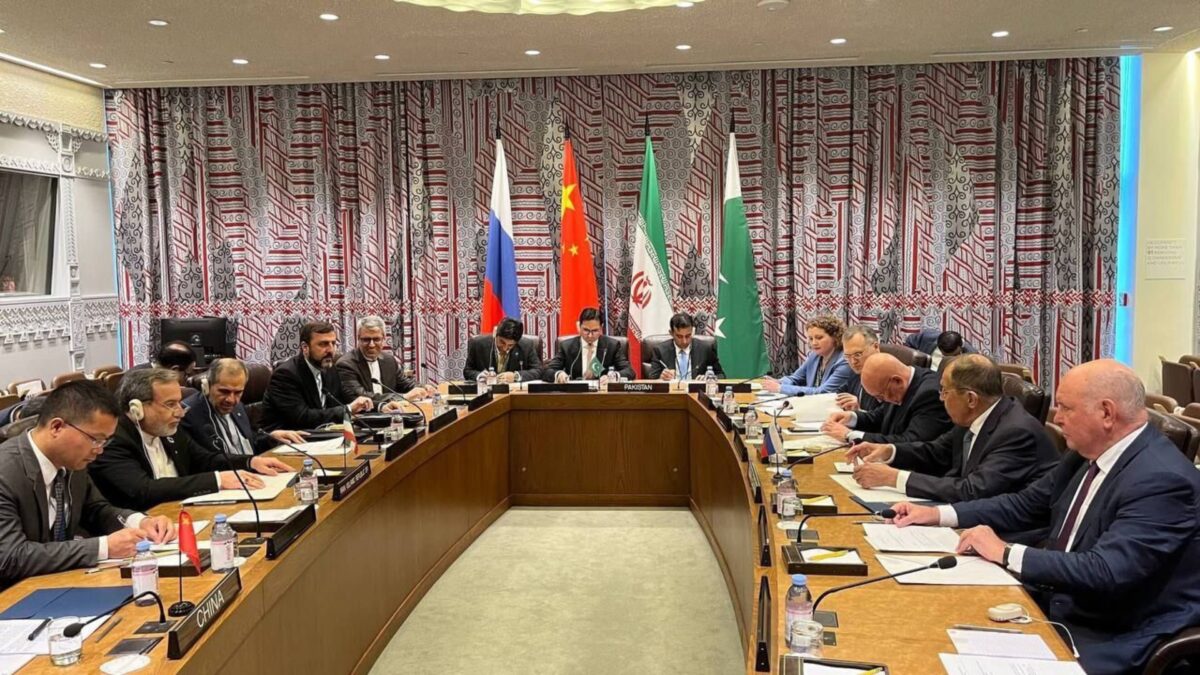
Pakistan, Russia, China, and Iran have jointly called on Afghanistan’s rulers to take concrete action against terrorist groups operating from its soil. The appeal was made during the fourth quadrilateral foreign ministers’ meeting on Afghanistan, held in New York on the sidelines of the 80th UN General Assembly session at Russia’s invitation. The ministers reaffirmed their commitment to seeing Afghanistan emerge as an independent, united, and stable country free from terrorism, war, and drug trafficking.
In a joint statement, the four nations expressed deep concern over security threats originating from Afghanistan. They named terrorist groups such as ISIS, Al-Qaeda, the East Turkestan Islamic Movement (ETIM), Tehrik-i-Taliban Pakistan (TTP), Jaish al-Adl, and the Balochistan Liberation Army (BLA) as serious threats to regional and global peace. The ministers urged Afghan authorities to dismantle these organizations, halt recruitment and financing, and close all training centers and support structures that enable terrorism.
Read more : No plans to recognise Taliban yet, says Pakistan FO
The foreign ministers also underlined the importance of regional economic cooperation to strengthen Afghanistan’s struggling economy. They emphasized that continuous economic support is vital to improve the living conditions of the Afghan people. Furthermore, they highlighted the need to adjust the 1988 sanctions regime to reflect ground realities and cautioned against double standards, particularly regarding travel restrictions on Taliban officials. They noted that since August 2022, Taliban leaders had been granted exemptions from travel bans nearly four dozen times.
Russia strongly criticized Washington’s recent moves to politicize the UN Taliban sanctions committee for its own narrow interests. The ministers stressed that restrictions should not be used as a political tool and urged fairness in applying international commitments. They further called for the release of Afghanistan’s frozen assets and opposed the establishment of any foreign military bases in or around Afghan territory.
The joint statement also appealed to the international community to provide urgent humanitarian aid to the Afghan people without political discrimination. The ministers underscored that humanitarian assistance must continue to flow consistently and without interruption. They also expressed appreciation for Afghanistan’s progress in reducing poppy cultivation but voiced concern over the growing production of synthetic drugs such as methamphetamine, urging coordinated global efforts to tackle narcotics networks.
Finally, the ministers placed responsibility for Afghanistan’s current crisis on NATO member states, stating that the alliance’s past actions left behind instability and insecurity. They reiterated their call for lifting unilateral sanctions, ending foreign interference, and ensuring Afghanistan’s sovereignty while promoting peace, stability, and development in the region.