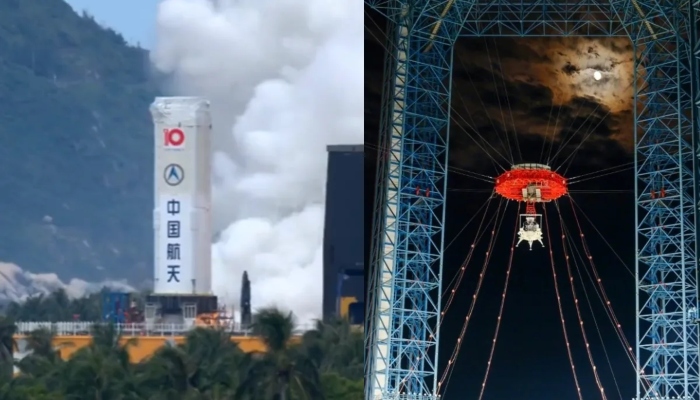
China has achieved significant milestones in its plan to send astronauts to the Moon by 2030. In August 2025, China successfully tested two crucial components of its lunar mission program. First, it conducted a successful takeoff and landing test of the human-rated lunar lander, called Lanyue, in Hebei province. This marked the first time China tested a human-carrying spacecraft’s takeoff and landing capabilities.
The second important test involved a static fire of the Long March 10 carrier rocket at the Wenchang launch site in Hainan. The test fired all seven engines of the rocket’s first stage, signaling an important step in China’s manned space program. The Long March 10 rocket is 92.5 meters long and will be used to carry astronauts and cargo between Earth and the Moon.
According to the China Manned Space Agency (CMSA), the Lanyue lander will carry astronauts between lunar orbit and the Moon’s surface. It will also carry scientific payloads like rovers and serve as a life support, energy, and data center to assist astronauts on the lunar surface. The CMSA described these tests as key achievements that bring China closer to landing its first astronauts on the Moon.
The Long March 10 series rockets will play a crucial role in China’s space missions, including transporting crewed spacecraft and landers for lunar exploration. The Long March 10A variant is a two-stage reusable rocket currently used to support China’s space station operations. These developments mark a significant leap in China’s ambitious lunar exploration efforts.
With these successful tests, China demonstrates its growing capability and commitment to becoming a major player in human space exploration. The country aims to send its first astronauts to the Moon by 2030, showcasing rapid progress in space technology and exploration.