
• Skip to primary navigation
  • Skip to main content
  • Skip to primary sidebar
  • Skip to footer
Trending:
  • Kashmir
  • Elections
Saturday, June 13, 2026

Daily Times

Your right to know

  • HOME
  • Latest
  • Iran-Israel war
  • Gilgit Baltistan Election
  • Pakistan
    • Balochistan
    • Gilgit Baltistan
    • Khyber Pakhtunkhwa
    • Punjab
    • Sindh
  • World
  • Editorials & Opinions
    • Editorials
    • Op-Eds
    • Commentary / Insight
    • Perspectives
    • Cartoons
    • Letters to the Editor
    • Featured
    • Blogs
      • Pakistan
      • World
      • Lifestyle
      • Culture
      • Sports
  • Business
  • Sports
  • E-PAPER
    • Lahore
    • Islamabad
    • Karachi
Shaikh Abdul Rasheed

Shaikh Abdul Rasheed

The Raving ‘Masoom Shah Jo Minaro’

Published on: November 2, 2017 4:44 AM

Masoom Shah, was a 16th-century Sindhi Muslim historian, physician, poet and pharmacist and is better known for writing two manuscripts on the history of Sindh, called “Tarikh-i-Sindh” and “Tarikh-i-Masoomi.” In 1598, Mughal Emperor Akbar, appointed him as the governor of Sindh and Sibi and the Nawab of Sukkur where he constructed a minaret now called the Minaret of Masoom Shah in 1617.

Syed Nizamuddin, known as Mir Muhammad Masoom Shah was born at Bakhar, near old Sukkur. He received his education from Allama Moulana Muhammad Bakar Rori and Moulana Muhammd Usman Kingri. Masoom Shah was at the time, a sixteenth-century Sindhi Muslim historian, physician, poet and pharmacist and is better known for writing the history of Sindh called “Tarikh-i-Sindh” and “Tarikh-i-Masoomi”, in Sindhi language. In 1598, Mughal Emperor Akbar the Great, appointed him as the governor of Sindh and Sibi, and the Nawab of Sukkur, where he constructed a minaret now called the Minaret of Masoom Shah.

His descendants still live in old Sukkur where he lived before and during his reign as the governor and nawab. The minaret and other architectural sites that he commissioned are now under the control of the Masoomi family. However, the government of Sindh has taken management control of this historical and monumental architecture.

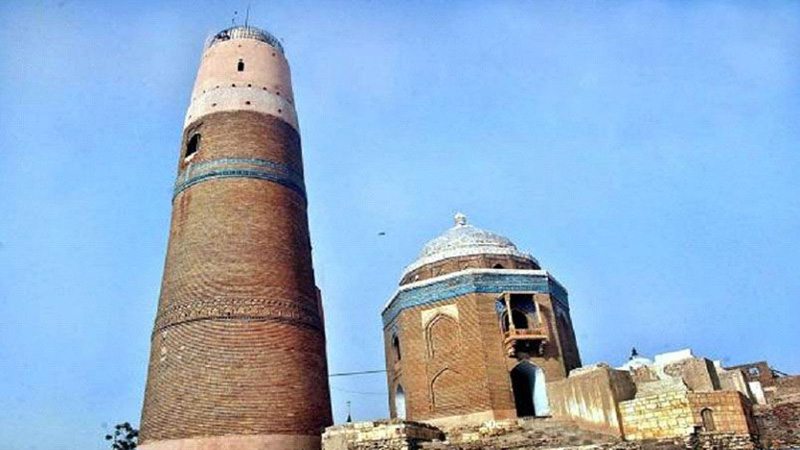
The towering architecture of the minaret now known as the Minaret of Masoom Shah and called ‘Masoom Shah Jo Minaro’ in Sindhi language is situated in the heart of Sindh’s third biggest city, Sukkur. According to some historians, construction work of this building was initiated in 1594 and was completed in 1617. This structure is more and less conical in shape, slightly off the perpendicular and surmounted by a dome to which an internal stone staircase gives an access. The monumental structure is adorned with floral work and poetry of Mir Masoom Shah at main entrances. It has four storeys and each storey has one arch shaped opening for ventilation.

For the construction of the classical minaret, red bricks made of special stone were brought from Jaipur in present-day-India. The stone was crushed into powder form and then molded into bricks, which were boiled in oil. The bricks were plastered together with a mixture containing lentils, crushed bones of goats, cows and other animals, sand and water. The magnificent structure with 84 steps in the staircase is around 31 meters high, and around 26 meters in circumference. The minaret viewed easily from miles away is believed to have served as a watch tower.

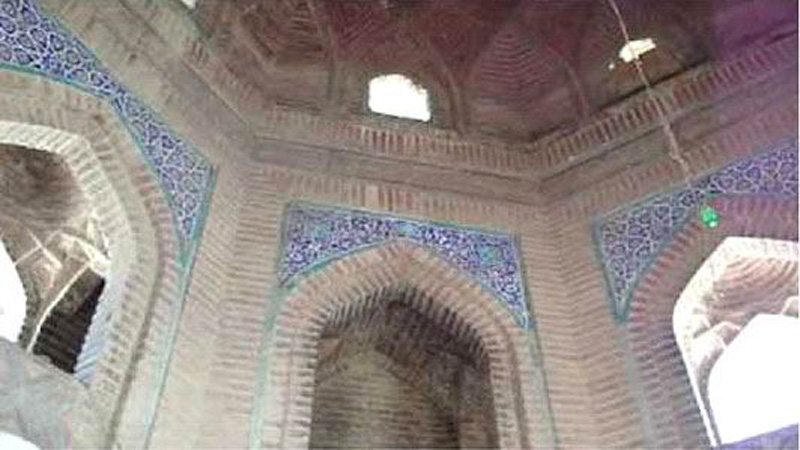
Around the minaret, including the beautiful shrine of Mir Masoom Shah, there are a number of graves of his ancestors. The pavilions exquisitely adorned with Quranic verses and Persian inscriptions are made of red sand stones, red bricks marble and glazed tiles.

Regrettably, because of the lack of interest and negligence of the Sindh government, the unique architecture has been losing its originality and exquisiteness. The stairs have gotten slippery, the people have to pace up and down the stairway very carefully and slowly to avoid falling down.
Repairing, renovation and maintenance work was done at the site 20 years back in 1998, by the Archeology Department of Sindh. The minaret generates a huge amount of money annually, as the Auqaf department charges visiting fees from the visitors.

The writer is a freelance columnist from Shikarpur, Sindh

Published in Daily Times, November 2nd 2017.

Filed Under: Uncategorized

Submit a Comment


Primary Sidebar


Latest News

Govt unveils Rs 18.8tr federal budget, projects 4% growth

PM confirms ‘final, agreed upon text of Iran peace deal reached’

Government limits development expenditure to boost defence spending

PML-N to help PPP form GB government

Government cuts petrol price by Rs 4, diesel Rs 2 per litre

Pakistan

Govt unveils Rs 18.8tr federal budget, projects 4% growth

PM confirms ‘final, agreed upon text of Iran peace deal reached’

Government limits development expenditure to boost defence spending

PML-N to help PPP form GB government

Government cuts petrol price by Rs 4, diesel Rs 2 per litre

More Posts from this Category

Business

SpaceX soars 23% in Wall Street debut and makes Elon Musk the first trillionaire

Petrol pump owners demand monthly fuel price review

President approves PIA’s privatisation bill

PSX gains over 2,696 points

Rupee gains three paisa against dollar

More Posts from this Category

World

S Korea’s ex-president gets 30 years over N Korea drone incident

India migrant evictions seed fear in Bangladesh border towns

Hate speech spreading ‘faster than ever’, warns UN chief

More Posts from this Category


Footer

Home
Lead Stories
Latest News
Editor’s Picks

Culture
Life & Style
Featured
Videos

Editorials
OP-EDS
Commentary
Advertise

Cartoons
Letters
Blogs
Privacy Policy

Contact
Company’s Financials
Investor Information
Terms & Conditions

Facebook
Twitter
Instagram
Youtube

© 2026 Daily Times. All rights reserved.

Manage Consent
To provide the best experiences, we use technologies like cookies to store and/or access device information. Consenting to these technologies will allow us to process data such as browsing behavior or unique IDs on this site. Not consenting or withdrawing consent, may adversely affect certain features and functions.
Functional Always active
The technical storage or access is strictly necessary for the legitimate purpose of enabling the use of a specific service explicitly requested by the subscriber or user, or for the sole purpose of carrying out the transmission of a communication over an electronic communications network.
Preferences
The technical storage or access is necessary for the legitimate purpose of storing preferences that are not requested by the subscriber or user.
Statistics
The technical storage or access that is used exclusively for statistical purposes. The technical storage or access that is used exclusively for anonymous statistical purposes. Without a subpoena, voluntary compliance on the part of your Internet Service Provider, or additional records from a third party, information stored or retrieved for this purpose alone cannot usually be used to identify you.
Marketing
The technical storage or access is required to create user profiles to send advertising, or to track the user on a website or across several websites for similar marketing purposes.
  • Manage options
  • Manage services
  • Manage {vendor_count} vendors
  • Read more about these purposes
View preferences
  • {title}
  • {title}
  • {title}
We use cookies to ensure that we give you the best experience on our website. If you continue to use this site we will assume that you are happy with it.