
 This is the 24th article in a special series by Ally Adnan that brings to life memorable incidents from the rich and fascinating life of Hazrat Amir Khusrau, whose timeless legacy continues to inspire the world.
During the development of the sitar, Amir Khusrau worked closely with master craftsmen on the creation of the instruments.
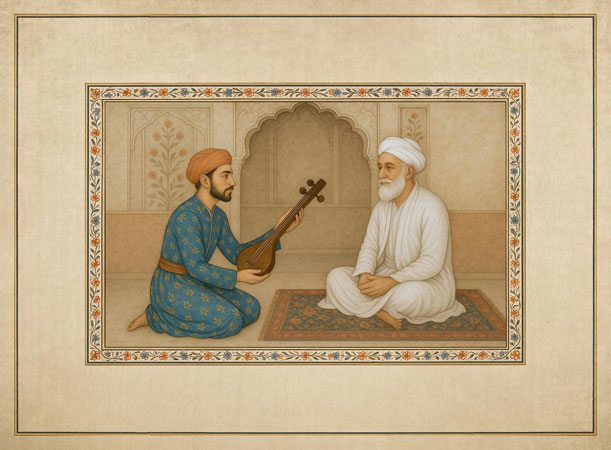
One of the sitars exceeded expectations. Its tone was extraordinarily precise, its appearance striking and its form both graceful and unique. Khusrau felt it was worthy of his master and took it to Nizamuddin Auliya’s khanqah to offer it as a gift. The Sufi saint smiled when he saw the sitar and held it in his hands, softly plucking its strings a few times to hear its tone before he spoke. “This instrument carries the sound of silence,” he said, “not the sound of melody.”
Khusrau was confused by the comment and reminded his master that the sitar did, in fact, produce music. Nizamuddin placed the sitar down beside him before responding. “When the heart falls silent,” he said, “only then does truth begin to be heard.”
In that instant, the meaning unfolded within Amir Khusrau, and he understood that the most tuneful of sounds lead to a peaceful inner silence that allows one to hear the truth. The poet was elated to hear his master acknowledge the power of the sitar’s music to lead the heart to silence, and he expressed the profound lesson in a seminal couplet which read, “True melody lives in the heart, not in strings and instruments; to know the secret, one must learn silence.”
The writer is based in Dallas, Texas and writes about culture, history and the arts. He tweets @allyadnanjanjua and can be reached at [email protected]